A few nice surface grinding services images I found:
Soviet 2K11 Krug long-range surface-to-air missile system. Советский ЗРК 2К11 “Круг”.
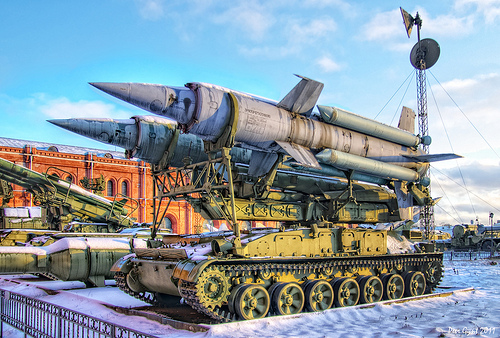
Image by Peer.Gynt
Artillery museum. Saint-Petersburg. Артиллерийский музей. Санкт-Петербург.
The 2K11 Krug (Russian: 2К11 «Круг»; English: circle) is a Soviet and now Russian long-range, medium-to-high altitude surface-to-air missile (SAM) system. "2K11" is its GRAU designation, while SA-4 Ganef is its NATO reporting name. The system was designed by NPO Novator and produced by Kalinin China Machine Building Plant.
Development of the Krug ZRK-SD (2K11) air defense system started in 1957 by the Lyulev OKB design bureau. It was first displayed during a parade in Moscow in May 1964. The system started to be fielded in 1967 and became fully operational in 1969. It was used by the Russian Army as a long-range SAM.
The early version of the Krug entered service in 1965. The first operational deployment version, the Krug-A, entered service in 1967, with extensively modified versions, the Krug-M in 1971 and the Krug-M1 in 1974, which were developed to rectify problems discovered during army service.[1] The upgraded version Krug-M was fielded in 1971 and the Krug-M1 in 1974. A target drone called 9M316M Virazh, developed from obsolete Krug missiles, was proposed for export in 1994.
The 2K11 was briefly operated by the Soviet army during the war in Afghanistan in 1979 and 1980, but was withdrawn several months after the initial invasion.[4] In 1997, it was reported[2] that, between 1993 and 1996, some 27 fire units of Krug and 349 missiles had been sold to Armenia. Poland flight tested four missiles in September 2006 against P-15 Termit (SS-N-2 ‘Styx’) targets.
The missiles are launched with the aid of four solid fuel rocket motors inside boosters attached to the outside of the massive missile. Once they have burned and the missile is aloft, it fires a liquid-fuelled ramjet sustainer engine. It reaches speeds of up to Mach 4 and has an effective range of 50–55 km (31–34 miles) depending upon the version. It carries a 135 kg (300 lb) warhead. Possible engagement altitudes range from 100 m-27 km (330-88,500 feet). 3M8 missile was designed and produced by NPO Novator.
Missile guidance is via radio command with a terminal semi-active radar homing (SARH) phase. Optical tracking is possible for the initial command guidance stage in a heavy ECM environment.
n service 1964–present
Production history
Designer Lyulev Novator
Designed 1957
Manufacturer MZiK
Variants Krug, Krug-A, Krug-M, Krug-M1, Krug-M2, Krug-M3
Specifications (2K11 Krug[1])
Weight 28,200 kg
Length 7.5 m (9.46 m with missiles)
Width 3.2 m
Height 4.472 m (with missiles)
Crew 3 to 5
Armour 15 mm
Engine V-59 V-12 water-cooled diesel
520 hp
Power/weight 17.33 hp/t
Ground clearance 0.44 m
Fuel capacity 850 litres
Operational
range 780 km
Speed 35 km/h
en.wikipedia.org/wiki/SA-4_Ganef
When It Exceeds Our Ability To Understand
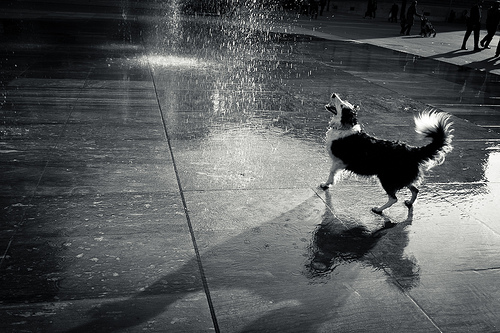
Image by Frederic Mancosu
UPDATE 2: Hi folks! In case you have been wondering why it has gone a bit quiet here in the last days, it is because I’m working on a non-photo project which is both vital and extremely consuming these days. I have to meet a deadline which is approaching way too fast for my liking and therefore am taken pretty much day and night. Regular service however will be resumed shortly after I’ll be done and will have handed in my paper. It is the longest piece I’ve ever written so far and it is beginning to eat every bit of me… I can’t wait to see it finished and I hate it dearly on the one hand. On the other hand, it is like a piece of my head ripped out and smeared across a couple of sheets of paper… or my screen for that matter. I do then love it at the same time… a bit like a (figurative) baby…
Oh and while I’m at it, thank’s Steve, for making the mac such a nice tool to write on.
************************************************************
UPDATE: Over 6000 views on the stream! Thank you all for the time you’ve spent here. Your visits are greatly appreciated and I hope you’ll continue to enjoy the images rolling out here over the next couple of weeks… or months, or years, who knows 😉
************************************************************
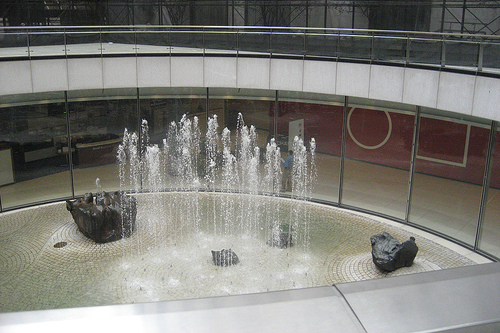
Bern Bundesplatz. We were sent to Bern with my China company yesterday and while we had a tight schedule, I still brought along my camera. I like Bern a lot and didn’t want to miss the occasion if we’d have a bit of free time left over. As it happened, we did and I didn’t. After we left the federal administration we had been visiting, we decided to remain in the area and enjoy the evening sun a bit on a café’s terrace. We therefore went on in the direction of Bundesplatz, a square right in front of our parliament, which has water fountains shooting out of it. In summer then, many kids toll around in the spray here (which you can see here: flic.kr/p/8mtC6M, here: flic.kr/p/8mwHRu or of course here: flic.kr/p/8mwACG).
With the winter coming closer however, they are way less prone to getting wet, which leaves the stage open for this dog, who was obviously very fascinated with the water shooting out of the ground. As they say then, when something exceeds one’s ability to understand, it becomes truly magical… even for a dog.
I took the occasion to get better befriended with my wide-angle and found out something significant about using such a lens in street-snapping. It was about light. So far, I had been shooting mainly at nighttime and therefore, my 24 had yet to encounter the mother of all light sources. Yes indeed, the sun. Granted, my photographical relation with the sun has not been without its ups and downs and quite frankly, I rarely like the light it provides. However, when it’s low enough, it creates dramatic contrasts and picturesque shadows, which in turn, are to be liked a lot. This then, is one domain where the wide angle feels really at home. It is a bit like its front lawn actually. Yes, in real life, the house behind the front lawn is where the serious bits are happening, where the inhabitant actually is who he is and does what he does. Following our analogy, the house is the proper use of the wide angle for the wide field of all it is able to do, landscapes, interiors, environmental portraits, the lot.
The front lawn though, is where the inhabitant shows off what he’s got best. A respectable car in the driveway signalizes success, a good trim on the grass denotes control and some carefully arranged beds of roses stand for style and a sense of esthetics… right out front, for the world to see. With a wide angle, it is quite similar and shooting it into a powerful light source like the sun makes for dramatic shots which show off its most valued qualities. The long shadows running at the viewer show of the singular depth one can achieve with no other type of lens, including the light source or at least its reflection into the frame creates a bright spot deep in the picture, drawing the viewer into it and if composed correctly, some context can still be given "around the image" due to the stretched field of view without being obtrusive.
While the world can of course not be made entirely out of front lawns and the properly great images remain the ones with message over method, this is still a valuable point to keep in mind on the steep learning curve one is presented with when using a 24mm lens.
About Transmilenio 1
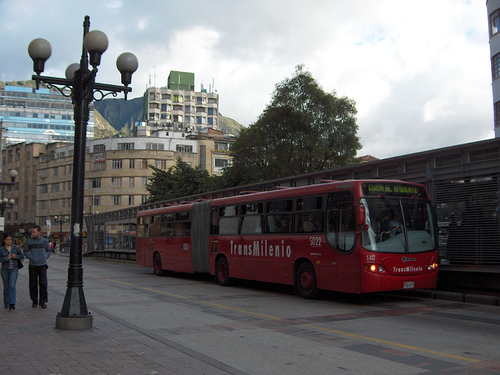
Image by adrimcm
Experiencing these stations was what most made me realise that there might actually be something to this BRT-thing after all:
And another flickr user’s photo (awesome capture): www.flickr.com/photos/doctorlo/2275173783/
Here are links to some short videos showing how the stations work:
Go to 0:52 on this one (actually a different system, but identical station style)
www.youtube.com/watch?v=hncSYjBQBIM&feature=related
www.youtube.com/watch?v=UA4IR7PvO6I
www.youtube.com/watch?v=vjP_GTnjEKI
The stations really frame the experience and provide numerous other services that improve the speed, capacity and comfort of the system as well as show a significant commitment/permanence by the local government/transit agency – like tracks they are not apt to be moved anytime soon.
The transmilenio is a BRT (for bus rapid transit).. like a cross between a metro and the express B-Line buses of Vancouver. Another way to put it (for those who don’t know Vancouver) would be like a surface metro – enclosed stations and all- that uses articulated buses instead of trains, and isolated lanes instead of track. Like skytrain, the station platform sits in between each direction of line.. but for TransMilenio, lanes. In this case, forming the long part of the "T" where the top is a crosswalk – right in the centre of the road (not on some distant, time-consuming pull-out)
The stations are well … they feel like the Expo line skytrain, but on the ground. There is ramp (wheelchair friendly) to go up to the bus-level platform, and one passes through automated fare collection (smart card). You can see a bit here: farm1.static.flickr.com/19/107068591_e6b678aa23_o.jpg Once inside, the entire station is all fare-paid zone, and buses on different routes each have a platform segment. This means that once one gets in the system (like a metro) you could actually ride all day. Each platform/bay has 3 wide sets of sliding glass doors that automatically open as the bus slides into position.
The 3 sets of wide glass doors of the station whisk open in unision with their bus counterparts (also wide) and riders step in and out (like skytrain, subway, or metro). There are no line ups. – People/wheelchairs/strollers simply step/roll in.. not up.. Wheelchairs and strollers are restricted to the front set of doors, everyone else uses the other two sets. . People transferring to another route just walk to the other bay/platform and get on that bus when it arrives without needing to pay again or queue for one door.
This system is far more cost-effective system than subsurface rail (most ROWs were expropriated from existing car lanes – transit priority over car), and there are no dangerous rails on the surface (and no fences like the around skytrain).
Also unlike something like the Silverline in Boston (which has a painfully slow transition to underground, and runs in mixed traffic, and generally oscillates between bus and wannabe metro), TransMilenio is completely consistent and uniform in what it has across the network.
The buses have their own median lanes, usually 2 in *each* direction. See how it looks here?: www.flickr.com/photos/99887786@N00/2468594299/ I would guess about 65% of the network is like this, and the remaining stations have passing lanes. This was a politically gutsy move to make, as the lanes the buses use were expropriated from car traffic. It basically creates additional congestion for cars, while allowing the cleaner more space-efficient public transit to go much much faster. A clear priority for public transit over car use. It is a carrot & stick. carrot to use transit becuase it is faster, stick against driving because it gets slower. In addition this is a major cost-saving measure, becuase existing roadways are used and no new ones are constructed (unlike other BRTs elswhere)
It also made construction of the busways incredible simple and fast. Nearly 100 kms of dedicated lines were in place within a matter of a few years.
My favourite resource for Bus Rapid Transit systems is the ITDPs BRT Planning Guide – in particular The Annex Section has system comparisons across BRT Systems all over the world. It is clear here how feature-rich TransMilenio is compared to lacklustre cousins elsewhere. itdp.pmhclients.com/index.php/microsite/brt_planning_guid…
Another good one: The US Transportation Research Board has a paper discussing applicability of the Transmilenio in the US – an identified challenge is that there could be little public support since most people would initially associate it with "the bus" rather than it’s own mode.
TransMilenio has immense capacity – moving more people than many heavy-rail subway systems – at peak hours the busiest single line moves 45,000 people per direction. In some ways the system is victim of it’s own success – some residents have nicknamed it TransMi-lleno (full), for being famously full.
Please see the next photo – there is more info there about TransMilenio.
Another informative video is this one of the Rea Vaya – a South African BRT system heavily modelled after TransMilenio. The station interior pan starts at 3:37
www.youtube.com/watch?v=85xXs7JTt5k and www.reavaya.org.za/
And last an electric trolleybus BRT in Venezuela: www.insideyorks.co.uk/tbus/xmd1.jpg
Electric trolley-bus BRT in Venezuela: www.flickr.com/photos/venex/sets/72157600189865830/