The Portable Atelier, Nyc.

The Portable Atelier, Nyc.

A few nice metal parts china images I found:

The Portable Atelier, Nyc.
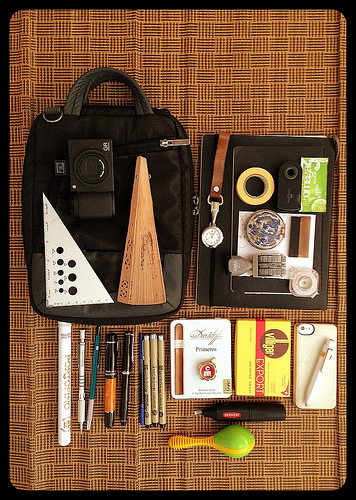
Image by atelier-ying
This is my camera bag that follows me everywhere, even inside my own home. I also toss it into the baby stroller.

Let’s take a tour starting clockwise from the upper left, shall we?

1. Turano iPad bag with 4 compartments and some dividers. I wish they made this in red or army green or clear smoky plastic.
2. metal drafting triangle, I did forget to include my elliptical and circle templates which I use.
I have a miniature engineer’s scale but there’s no real reason to use it for what I’m doing, my cameras designs stand without toppling over and there’s no standardized dimension of camera building materials to concern myself over. Actually, glue, tape, and architectural modeling supplies are my materials for the most part.
3. the Ricoh GRD3 is tuned for taking only baby photos. I treat it like a film camera; I don’t use the LCD at all, it’s got two settings for color or b&w, and I toss the used chips into a small plastic box. I will have to spend a week on the computer downloading and editing, maybe when my kids turn two years of age.
4. old-fashioned fan. I really use this. it feels so good in the hand, very practical. And good for fanning a restless baby in the stroller. I’d like to get a sandalwood one from HK.
5. Moleskine notebooks. The largest one fits in the Turano, amazingly. I have many sizes of these black notebooks. Actually, I have a red suitcase from my childhood full of nothing but notebooks.
6. Name seals and red ink paste.
7. Office date stamp
8. Muji measuring tape, in millimeters, you never know when you need to measure camera dimensions and distances.
9. Yellow tape, pencil sharpener (sandpaper works best, I find)
10. Coromega (the best Omega supplement and this brand causes no heartburn)
11. my quasi-conductor’s watch made from a complimentary Michael Kors sample attached to a 70’s key strap.
12. iphone and cover and 5mm kaweco lead holder, both in white and brass, my favorite color combo. I want a white and brass kit. Drawing with the Kaweco is a real pleasure. I upload all my drawings with the iphone, from anywhere.
13. Swiss Villiger Cigar box filled with clay scratchboard papers for drawings. I’d like to store an old-world gambling dice game, or a golf game in here too. Like the old Howzat game. I’m working on it.
14. Davidoff Primeros, the best small cigars I have ever had. There is a relic of St. Therese de Lisieux on top of the box. It’s a piece of her habit. It blesses all my efforts.
15. Micron Pen set (.005, .01, .08 sizes)
16. Muji ink refill in gel blue, wonderful scriber’s tool.
17. Namiki Fountain Pen with red ink cartridges. I wish they’d make a vermillion red ink. I can do all my drawings in red, I love the impact and color.
18. Delta La Dolce Vita Fountain pen with Fine nib. The opposite of the ink refill pen in size and feel.
19. HB lead holder
20. Promecha Super Pencil. A work of art in itself.
21. Macanudo Portofino tube with sandpaper for sharpening leads
22. Derwent Electric Eraser, one of my favorite tools, I cannot live without this when I am drawing.
23. Baby’s Rattle. This is one of the best baby pacifiers I know of. Always handy to quiet the little ones.

A Ticket to Ride the TranSiberian
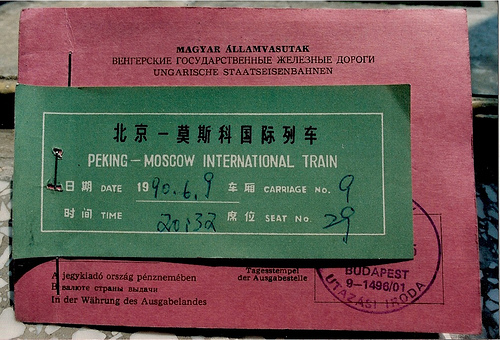
Image by Viewminder
Cut off from the sea by the suspicious port authorities in Shanghai it seemed that the only way I was going to get out of China was overland. This was my ticket.

In Shanghai I had inquired of every traveler I met about the path ahead of me. I had heard tales of this magnificent and exotic railway adventure before… they called it the greatest railway journey on earth. The longest stretch of steel rail ever layed.

An Australian traveller named Mark told me that he had heard that there was a guy in Beijing who could get me a ticket.

I asked Mark how I could find this guy in Beijing. He said just go there and ask for ‘The Crocodile.’ Just go to a city of some ten million souls and ask for ‘The Crocodile’? It sounded almost insane to me.

Ditching Mark after he made moves on my Chinese girlfriend and ditching my Chinese girlfriend after she got all worked up when a soldier who was following me took a picture of us together on the riverfront… I understood her fear in that time of Tienenmen Square and I knew it was time once again to get moving. It was time to move north to Beijing… the city they once called Peking.

Tsu Tsu Mei was a nice girl. She had told me to call her Eleanor… because that was what she called her ‘American name.’ I couldn’t do it because she just didn’t look like an Eleanor to me… I always called her Tsu Tsu Mei. And I think that she really liked that I did… it would have been easier to call her Eleanor I’m sure… but each time I called her ‘Tsu Tsu Mei’ she gave me this look… it started with a big warm vulnerable smile that made it seem to me that she was melting inside with warm thoughts and shaking knees.

That look always made me want to scoop her up in my arms and give her the same feelings right back. Whenever I said her name and got that look… it just kind of summed everything up right there in that moment. I really liked that. Sometimes I wished that it had gone farther but the way it ended is why I have the memories I do… and I hope she does too… we never hurt each other… never not once… it was the hard and cold government of an opressive authoritarian regime that broke both of our hearts there in Shanghai. It wasn’t either of us… it wasn’t our fault.

I was with Mark the Australian when I met Tsu Tsu Mei… we were tooling around Shanghai and we had just gotten on the bus after a tour of the Shanghai Waterpipe Factory Number Seven where I had just purchased a fine example of a brass opium waterpipe. We had seen the place while riding the bus and jumped off… the factory was really happy to have foreigners tour the place. I couldn’t believe that there were at least six other water bong factories in Shanghai. Somehow we had found the seventh.

As foreigners we were pretty much used to talking in english right in front of people knowing full well that they couldn’t follow our conversation… especially the slang riddled prose we frequently used. When Tsu Tsu Mei got on the bus and stood next to me I turned to Mark and said "man she is the most beautiful Chinese woman I have ever seen."

Before Mark could agree… Tsu Tsu Mei let me know that she appreciated the compliment… she smiled and said "thank you" in perfect english.

Shocked that my subterfuge was exposed at first I was a little embarassed… until Mark took that half of a second to start in on her. No way I thought… I was the one who paid the compliment… I was going to be putting the moves on Tsu Tsu Mei. I’m not sure Australian guys understand the concept of a good ‘wing man’ but Mark sure had some learnin’ to do. He needed to watch the movie ‘Top Gun’ and take some notes.

Tsu Tsu Mei and I arranged to meet later that night in downtown Shanghai and proceeded to become great friends. She even took me to meet her parents… Norman Tsu… the first deaf technical drafting instructor in all of China and his ‘deaf wife Janie.’

Tsu Tsu Mei’s father Norman was sent to the United States to study technical drafting in the fifties. He went to Gaudellet University and he confided in me that he really liked it… that he didn’t want to come back to China… he stopped writing home and corresponding with the government… he wanted to drift away… but they corralled his mother who was a widow by this time… and they made her write Norman a letter that made it really clear that it was in her best interests that Norman return to China. That’s how China got its first deaf technical drafting instructor. Or how they got him back.

Norman always referred to his wife as ‘My deaf wife.’ Both of them were deaf and we passed notes to each other over a marvellous dinner… while Tsu tsu Mei just kept smiling at me and at her parents… unbelievable food Normans deaf wife cooked. It was a feast… and not the Chinese food I was used to… this was exotic and unknown to me. The Tsu’s really went out and they’ve been in my thoughts many times since then.

The Tsu family was really good to me and things were moving right along with Tsu Tsu Mei too until that soldier decided that he’d turn our little hand holding session on the Shanghai riverfrint into a Kodak moment. I had seen that guy following me before… he was the tallest Chinaman I’d ever seen… a full head above the rest of the general population. I found great amusement in shagging him… going into a store and going out the back door. It was really like a game. Still… he always found me… he was on me for days there in Shanghai. And after he took that picture I realized that my company with Tsu Tsu Mei wasn’t looked upon favorably by the authorities. She was terrified of the repurcussions. I knew that was it… I wasn’t going to get her or her family inot any trouble. I was going to get out of Shanghai.

I purchased a train ticket on a sleeper train for the seventeen hour ride from Shanghai to Beijing. How was it that I could go to a city the size of Beijing almost a thousand miles to the north and find this man called ‘The Crocodile’ simply by asking? It seemed completely insane… but such was the world I found myself in this year… for me, 1990 was the year of living insanely.

After seventeen hours of watching China slide by through the window accompanied by the soundtrack of nonstop kung fu videos on the train’s television sets, I stepped off the carriage in Beijing, China’s capital city. Which was a godsend because I could not have taken one more of those videos. The Chinese truly love them… they must be a part of their national identity… the way that the Japanese love Godzilla. Godzilla was a mechanism that helped the Japanese to cope with their loss of World War Two and the painful shock of getting Nuked twice. Even though Godzilla always stomps their cities to pieces they always triumph. It’s like a morality tale with them.

When I was living in Osaka someone who worked in the studio that made the Godzilla movies decided to borrow the costume and wear it to a party where he caused it to be damaged to the tune of a hundred and seventy five thousand dollars. I wish I was at that party. Hanging out with the Nigerians. That would have been epic.

The first european looking guy I saw in Beijing… I stopped him as was my custom in the orient and inquired of the conditions and opportunities there in this new city. Blonde hair in China or Japan had always meant ‘help desk’ to me. We vagabonds and adventurers always stuck together and usually became instant friends as long as there wasn’t a woman involved.

Then I asked him if he had ever heard of ‘The Crocodile.’

He said that he would take me to see him right now. Right then. Right there. Unbelievable. I’m not kidding. No shit. I couldn’t believe it either.

I had found ‘The Crocodile.’

The man walked me to a hotel a few blocks away from the railroad station. It was an old building that looked straight out of the 1920’s, like just about every other building in Beijing. You could see that it was really beautiful at one time… maybe even opulent or exclusive… but it, like anything else that was once beautiful or opulent, it seemed to fall into despair and decay under the custodianship of the communists. That was the way pretty much all of Beijing looked. With brown air and trees and bushes that were different from all those I had even known. I always notice the trees and bushes in a new city. Here on the other side of the world the plant life and the vegetation was odd to me… just unusual enough to stick out in my mind.

The man knocked on the door and we were answered by a nice looking blonde woman on her early twenties. She looked kind of pissed off but invited us in still. My guide just turned around and left with little more than a gesture to the woman. I followed her into the room.

It had become a bit of a self entertainment for me to wonder why the man I was seeking should be called "The Crocodile." It intrigued me from the moment I had heard it and in my mind I came up with all sorts of reasons for the nickname. None of them pleasant.

The room was an illustration in contrasts… inside "The Crocodile" had rented two rooms… he knocked down the wall that had seperated them and completely remolded it. This guy was livin’ cush. He sat on the edge of his bed playing with the tv remote control as if it had befuddled him… I could tell from body language that his girlfriend and he had just been fighting.

"The Crocodile" stood up and turned around to face me… the guy must have been six and a half feet tall… and immediately I could see why they called him "The Crocodile."

He wore these braces on his teeth… the largest mass of metal I’ve ever seen in a persons mouth. Communist braces aren’t very pretty… but these… "The Crocodiles" mouth looked like it had been installed by a blacksmith… an angry, drunken blacksmith. Like hammered bars of hot metal hand forged around each of his teeth.

I had to make myself stop staring as he got right down to business. Croc asked me when I wanted to leave… he said he had one ticket and he wanted a hundred and ten bucks American for it. There’d be no negotiating I could tell that right away. I had a feeling that if I tried that he’d have just relieved me of all my dough right there. Probably my gear too.

We were in a bit of a funny situation for a couple of reasons… I thought the ticket looked fake… it looked worse than some of the permits and passes I’d forged in school. I didn’t have a visa to enter Russia… and I didn’t carry that kind of currency in US dollars. I wasn’t too sure that the Russians would actually be too excited about me coming to their country either. When I expressed this to "The Crocodile" he laughed a powerful and boisterous laugh and told me not to worry about it… he’d just gimme the ticket on good faith… so I could try and get a visa and cash a travellers check or something to come up with the Dollars he wanted. Besides he said "I know where your seat is and when you’ll be leaving and if you fuck me I’ll kill you" after which he laughed another deep laugh and gave me a half hug. "I want my money by next week he said." and walked me to the door where he said goodbye and his girlfriend gave me another dirty look.

That was it. Absolutely fucking unbelievable. I’m in Beijing less than two hours and I found my guy and I got my ticket. Now I just needed a visa from the Soviet Consulate. He’d also tell me there if the ticket was real I figured.

But right now I needed a place to stay. That would have to be my first order of business. The Croc’s hotel seemed a little too luxurious for my budget… I needed something ‘dumpier.’ Something where my kind’d fit in you know?

I walked out of the hotel and on to the street… pausing for a moment to take a breath of the sulfery yellow tinged air and feel the pulse of the street there…a moment to let the vibe of it all sink in. I could have gone left or I could have gone right but it really didn’t matter because I had no idea where I was going anyway. It’s like a rule with me… like walking on the upwind side of the street because that’s where all the paper money blows. Go left.

My friend Joel… the guy who’d saved my ass from the knife weilding Yakuza that pressed certain death into my throat in that bar in Osaka… he told me that he went insane and that he would hear these voices in his head that always said the same thing… "look to the left Joel." If he wasn’t crazy already he said that those voices would do it… he never understood the meaning of it. Stupid voices in your head… they never tell you anything good… like "stay away from that one… she’s trouble." They’re always all cryptic. You gotta try to figure them out and break the code. Joel said the lithium they gave him pretty much shut the voices down. I never had heard voices though. It would probably be fun for a day or two… just to see what they would say. I think if I had voices they would sound like Vincent Price on LSD.

So I went left after I walked out of the Crocodile’s hotel. I usually always go left when I got no idea but this time I was especially glad I did.

I get about a block and right there smack dab… badda bing… I run into this guy I lived with in Osaka Japan… Mike Levine… a Jewish guy from Jersey. He had let me borrow a pair of his shoes because I could find any in my size in Japan. Mike’s got this big smile on his face as he sees me… we hug and slap each others backs and talk about the fight that got me thrown out of the university in Japan that we both went to.

Mike gave me directions to a suitably dumpy hotel and we parted ways.

Walking down the street I saw a couple of American girls… who turned out to be two really granola looking lesbian backpackers from Nebraska.

I stopped them there and asked them where they were staying… they said they had no idea… I invited them to share a hotel room with me if we could find one… plus the thought of girl on girl action sounded like really good fun to me. I felt like I was really going to like Beijing. It seemed like an easy city. Things were looking good.

Was this my lucky day or what?

Shit, I been here for like two hours… I already met the guy I came to meet, had a ticket for the Trans Siberian, hooked up with two lesbians and there we found a three dollar a night hotel. Six yuan a night for each of us. What more greatness could god bestow on me? Another lesbian? A blind supermodel? That would just be asking too much I thought. Lady Luck, I’ve always said, she was indeed a friend of mine.

Never look a gift horse in the mouth they say… so I unpacked my gear in the hotel room… every bit of it… and spread it all around. I always unpack fully so if I get robbed they can’t just take one bag and split… they gotta work for it… then I unscrew all the lightbulbs in the room so they gotta have a flashlight to do it well… and then I make some loud noise making booby trap… like a pyramid of empty beer cans behind the door… then they gotta have nerves of steel to finish the job. Never got robbed once. Never. I have come home more than a few times affected by some intoxicant or another and fallen vicim to my own booby traps though. It always scared the beejesus out of me.

The Nebraska lesbians unpacked too.

Time to get out of here… It was time to go have a look at Beijing.

I left the hotel in a hurry and jumped on the first bus I saw… it didn’t matter where the bus was going…I didn’t care… I was sure that I hadn’t been there anyway. That’s the great thing about exploring like that. A new city… just go anywhere. It’s all new.

Sitting on the bus I was of course the only westerner riding it. The Chinese weren’t as polite as the Japanese and they would just stare at you forever… sometimes with mouth agape even… and I found myself very much the center of attention… the center of attention was something I really didn’t want to be. I kinda wanted to blend in really. That was going to be tough.

I started having what could only be described as auditory hallucinations on that bus… that happened alot to me in China… but right there it was bad… the cacaphony of Chinese voices started to filter itself out in my hyperactive mind and become english… I could understand things sometimes… I was certain that people were commenting on how intoxicated I was… they all knew it… they were all talking about me… looking at me… ‘Is that American guy drunk out of his gourd or what?’ I had to get off that bus. The sweat was pouring from my pores. It was getting to be more than uncomfortable… it was unbearable.

The next stop was my stop no matter where it might be… soon as it stopped I jumped off that bus so fast… I didn’t even have a clue as to where I was… and I didn’t care. Away from that hash house hotel and off of that bus…I just wanted my own little piece of contraband free real estate where I could sit and watch China go by and make amusing comments in my head to entertain myself.

This was my stop.

Before me was layed an enormous plaza… I had never seen such a large paved public space. It was gigantic enough it looked like you could lay down and land a 747 in it if you went from one corner to the next. It was so big and vast that the smog of Beijing obscured the other side of it from me. I didn’t know what this place was, but it made me feel realy small… insignificant actually… which was precisely how I wanted to feel.

I stood at Tienenmen Square.

This was the old Beijing… the one that used to be before the extremely systematic exploitation of cheap labor turned the place into a giant pachinko parlor… this was the dirty, dusty and gritty beijing where products were pulled around on wagons by teams of horses who shit big piles in the streets that you’d go straight over the handlebars of your bicycle if you didn’t look where you were going. I’d seen it.

This was the Beijing where the streets seemed impossibly large considering no one really owned a car… the Beijing where the old people all wore those navy blue or black or gray kung fu outfits and walked around stooping with their hands clasped behind their backs as if some ultimate power had ordered them to for all time.

This was the square in Beijing where less than a year had passed since thousands of students took a chance to try and change their world… this was the Beijing where tanks had rolled over them without mercy and their bodies were torn apart by the callousness of lead flying around at ballisticly high speeds and cruel random trajectories. This was the Beijing where their blood ran like rivers down the curbs and into the sewers where like the extinguishing of their tender lives for naught all was soon forgotten by a world more infatuated with its demand for cheap consumer electronics in attractive clamshell packaging.

The one year anniversary of the slaughter was approaching and here as if by accident I find myself in the place where history was made and so conveniently forgotten.

Here and there I could still see bullet scars, burns and other marks that told the tale of a failed movement killed in a single night of murderous debauchery.

It was eerie in Beijing. I couldn’t put my finger on it. Was it just the intoxicant’s influence? I couldn’t place it until I found a nice grassy place to sit down and let everything stabilize. Let my altered mind stop spinning.

The young people were all gone.

The government had sent what looked like the entire youth of the capitol city to ‘summer camp,’ where they’d sing patriotic songs and watch lots of motivational films and learn the error of their ways. It was re-education for the entire young population… there was almost no one walking around that city bettween the age of fourteen and twenty one. It was spooky… strange mojo in a strange land. Like some kind of Twilight Zone episode.

Everybody’s seen the picture of ‘Tank Man,’ that guy whose name the world doesn’t know… the one who was walking home from the grocery store with a couple of plastic bags in his hands… the guy who became a lonely human roadblock for a column of tanks… I know I could never forget that guy… he had balls the size of watermelons that one. I woudda love to have bought that guy a drink or eight.

I was walking down that street and a momentary sense of deja vu made me stop… It felt like I’d been there before… it didn’t take too long for the reality to hit me… I was standing in that spot. In the Tank Man’s spot. The premonition came from looking at that photograph.

There was a pay phone there… on the side of the street… you can see it in the Tank Man picture… I thought my parents might like to know where in the world I was so I tried to call them from it without luck. Maybe they’d think it was cool that I was calling them from there I thought.

I wanted to feel the scene out… I wanted to let it all sink in a little bit so I sat down and I had a look around. It all began to unfold in my mind… the direction the tanks came from… the sounds they’d make… their squeaking tracks rolling on the asphalt echoing in the canyon of concrete buildings… I could see the crosswalk he was walking across when it happened.

I stood up, still painting the scene on the canvas of my mind with the brushes of my imagination and I walked towards the crosswalk… just as he did that remarkable day.

Man… sometimes even I have a hard time putting things into words… sometimes feelings, emotions and perceptions are just too powerful and swift to get a grasp on.

Surveying the scene where this historic collision happened from the street… it was so much different than the picture we all know… that was shot from high above… it’s got a whole different tone than the lonliness and isolation that the street level offered. Just like in the square where I had felt so small… even the street there was massive in width… one of those subcompact cars flying through the smog could have crushed me like a bug. The thought of standing my ground in front of a column of many ton armored tanks with their diesel engines shaking and belching thick black smoke and rumbling in anger… I’ll tell you this… with the greatest respect that I can muster… that guy… at that moment… he took on the entire world. He was a bad ass motherfucker who said ‘hey… I don’t like what’s going down here.’ and he backed it up with his hundred and fifty pound body alone in the streets. He never even put those grocery bags down. But for a moment, that man stopped the world. He stood his ground. He stood our ground. He stood for everyman that day.

I didn’t.

I didn’t even chance stopping where he did. I didn’t want to stop a bus.

When I got across the street I walked back towards Tienenmen Square wondering what happened to the guy.

These thoughts were crisply punctuated when I found the remains of a completely flattened bicycle. It had been run over by something pretty heavy because it was as flat as a bicycle could conceivably become. It even had a curve to it… a lot of parts were gone but the frame, the handlebars, even the rims were crushed flat. I picked it up, still thinking about Tank Man and I realized what it meant.

Something inside me wanted to take it home… to show my people… people born and raised with a freedom fought for by others… I wanted to show them what we pretty much let happen here… the great crime that we ignored. It was a strong symbol to me at least of an oppresive government that lost it’s temper on it’s own people.

I’d never get that flattened bicycle home, but I carried stashed inside the tubes of my backpack messages that people had asked me to carry out of the country to a place where mistakenly so they thought good and decent people might give two shits about the treachery bestowed upon them in their quest for what we have but could really care less about. A freedom so strong… a freedom so deep that it was a part of me wether I was conscious about it or not… a freedom that formed the person I was and carried me on a long and mostly accidental journey to a place where youth was cut short for having the audacity and lack of patience to demand a more tolerant society where people would count for just a little more than cheap labor.

I promised myself I’d remember what happened to them. I promised myself that on June 4th, 1990 that I’d say a prayer there in Tienenmen Square. I’d recognize their martyrdom to the cause of freedom and I’d pay my respects on the anniversary of the barbarism of their all powerful and vicious central authority.

When that morning came with its sultry brownish orange sunrise, three hundred and sixty five days after the blood letting, when the flag of a nation was raised over it’s most proud square… I was the only person that wasn’t Chinese standing there as a witness to at least offer the the quiet contempt of my heart and the objection of my soul as a counterbalance to the disgrace of the murder of these children.

There were no television cameras or satellite trucks… no journalists fixing their hair or taking notes on those long pads that they carry. Nothing.

I carried no sign or banner… I spoke no message of objection. I sought to instigate nothing.

I stood there in Tienenmen Square as a witness.

A witness to what the rest of the free world was so selfishly quick to forget.

Two days later I’d board a train that I’d get off of in another world… where a wall that represented hate and anger and mistrust would be falling, hacked to pieces bit by bit by a people celebrating a new freedom and unity.

Way to the future right now
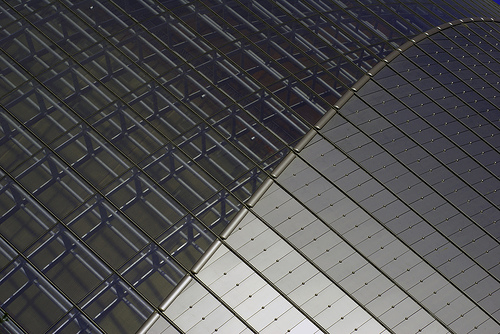
Image by aurelio.asiain
Much more better at a close approach: the unfinished National Grand Theater of China, in Beijing, next to the Great Hall of the People. With 150,000 square meters floor area, it was supposed to be finished and ready to have performances by 2005, but the construction is still going on. (This is part of a growing set, try running the slideshow first.)
stove knob extension

stove knob extension

A few nice cnc China Turning parts images I found:

stove knob extension

Image by jiskar
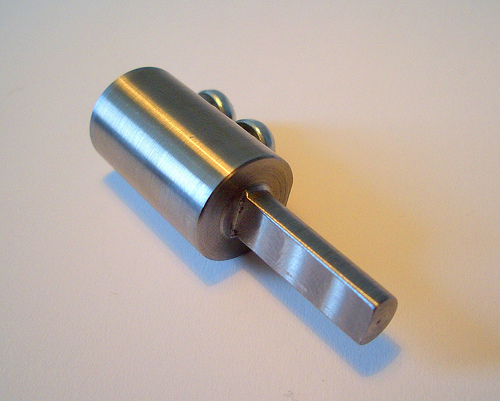
I had to repair a stove knob from whitch a little plastic extention thingy broke. This is the replacement part I made for it. A nice little project to get to know the design flow of my China cnc lathe. It’s stainless steel.


Image by cnkangrui
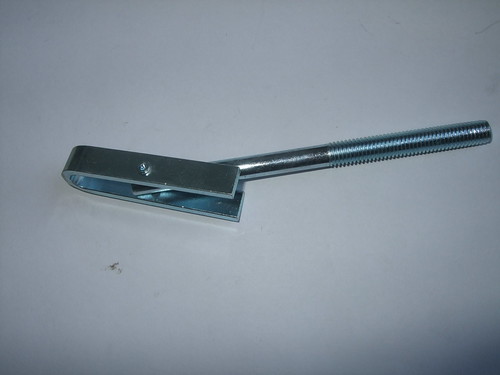
We can design and fabricate complex precision tooling ourselves, and process all kinds of precision metal parts as required. Good quality, professional teamwork, prompts communication service.
Our features:
Equipment:
We own Stamping machines, Hydraulic press machines, Auto-Turning machines, CNC-Turning machines, Milling machines, Precision wire China cutting machines, more than 60 sets in total;
Material:
Iron, carbon steel, stainless steel, brass, copper, alloy steel, aluminum, cold rolled steel with various plating;
Surface treatment:
Kinds of plating (Zinc, Nickel, Chrome, Tin, Ag); Painting, Powder, Anodizing, E-coating, Silkscreen, Heat treatment, Black oxides;
Drawings:We will design the Module according to the drawing you provided, and send the samples to you for confirm, we will make sure the samples as your need.
We are here ready to work together with you to develop our long-term business relationship and to prosper in the coming future.

Taj Mahal !!!

Taj Mahal !!!

Check out these china precision parts images:

Taj Mahal !!!

Image by Trains @Glance™ !!!
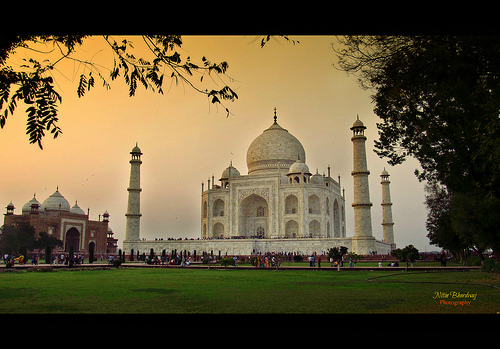
The Taj Mahal is a white marble mausoleum located in Agra, Uttar Pradesh, India. It was built by Mughal emperor Shah Jahan in memory of his third wife, Mumtaz Mahal. The Taj Mahal is widely recognized as "the jewel of Muslim art in India and one of the universally admired masterpieces of the world’s heritage"
Taj Mahal is regarded by many as the finest example of Mughal architecture, a style that combines elements from Islamic, Persian, Ottoman Turkish and Indian architectural styles.
In 1983, the Taj Mahal became a UNESCO World Heritage Site. While the white domed marble mausoleum is the most familiar component of the Taj Mahal, it is actually an integrated complex of structures. The construction began around 1632 and was completed around 1653, employing thousands of artisans and craftsmen. The construction of the Taj Mahal was entrusted to a board of architects under imperial supervision, including Abd ul-Karim Ma’mur Khan, Makramat Khan, and Ustad Ahmad Lahauri. Lahauri is generally considered to be the principal designer.

Origin and inspiration
In 1631, Shah Jahan, emperor during the Mughal empire’s period of greatest prosperity, was grief-stricken when his third wife, Mumtaz Mahal, a Persian princess, died during the birth of their 14th child, Gauhara Begum. Construction of the Taj Mahal began in 1632. The court chronicles of Shah Jahan’s grief illustrate the love story traditionally held as an inspiration for Taj Mahal. The principal mausoleum was completed in 1648 and the surrounding buildings and garden were finished five years later. Emperor Shah Jahan himself described the Taj in these words.

Should guilty seek asylum here,
Like one pardoned, he becomes free from sin.
Should a sinner make his way to this mansion,
All his past sins are to be washed away.
The sight of this mansion creates sorrowing sighs;
And the sun and the moon shed tears from their eyes.
In this world this edifice has been made;
To display thereby the creator’s glory.

The Taj Mahal incorporates and expands on design traditions of Persian architecture and earlier Mughal architecture. Specific inspiration came from successful Timurid and Mughal buildings including; the Gur-e Amir (the tomb of Timur, progenitor of the Mughal dynasty, inSamarkand), Humayun’s Tomb, Itmad-Ud-Daulah’s Tomb (sometimes called the Baby Taj), and Shah Jahan’s own Jama Masjid inDelhi. While earlier Mughal buildings were primarily constructed of red sandstone, Shah Jahan promoted the use of white marble inlaid with semi-precious stones, and buildings under his patronage reached new levels of refinement.

Tomb
The tomb is the central focus of the entire complex of the Taj Mahal. This large, white marble structure stands on a square plinth and consists of a symmetrical building with an iwan (an arch-shaped doorway) topped by a large dome and finial. Like most Mughal tombs, the basic elements are Persian in origin.
The base structure is essentially a large, multi-chambered cube with chamfered corners, forming an unequal octagon that is approximately 55 metres (180 ft) on each of the four long sides. On each of these sides, a huge pishtaq, or vaulted archway, frames the iwan with two similarly shaped, arched balconies stacked on either side. This motif of stacked pishtaqs is replicated on the chamfered corner areas, making the design completely symmetrical on all sides of the building. Four minarets frame the tomb, one at each corner of the plinth facing the chamfered corners. The main chamber houses the false sarcophagi of Mumtaz Mahal and Shah Jahan; the actual graves are at a lower level.
The marble dome that surmounts the tomb is the most spectacular feature. Its height of around 35 metres (115 ft) is about the same as the length of the base, and is accentuated as it sits on a cylindrical "drum" which is roughly 7 metres (23 ft) high. Because of its shape, the dome is often called an onion dome or amrud (guava dome). The top is decorated with a lotusdesign, which also serves to accentuate its height. The shape of the dome is emphasised by four smaller domed chattris(kiosks) placed at its corners, which replicate the onion shape of the main dome. Their columned bases open through the roof of the tomb and provide light to the interior. Tall decorative spires (guldastas) extend from edges of base walls, and provide visual emphasis to the height of the dome. The lotus motif is repeated on both the chattris and guldastas. The dome and chattris are topped by a gilded finial, which mixes traditional Persian and Hindustani.
The main finial was originally made of gold but was replaced by a copy made of gilded bronze in the early 19th century. This feature provides a clear example of integration of traditional Persian and Hindu decorative elements. The finial is topped by a moon, a typical Islamic motif whose horns pointheavenward. Because of its placement on the main spire, the horns of the moon and the finial point combine to create a trident shape, reminiscent of traditional Hindu symbols of Shiva.
The minarets, which are each more than 40 metres (130 ft) tall, display the designer’s penchant for symmetry. They were designed as working minarets—a traditional element of mosques, used by the muezzin to call the Islamic faithful to prayer. Each minaret is effectively divided into three equal parts by two working balconies that ring the tower. At the top of the tower is a final balcony surmounted by a chattri that mirrors the design of those on the tomb. The chattris all share the same decorative elements of a lotus design topped by a gilded finial. The minarets were constructed slightly outside of the plinth so that, in the event of collapse, (a typical occurrence with many tall constructions of the period) the material from the towers would tend to fall away from the tomb.

Exterior Decorations
The exterior decorations of the Taj Mahal are among the finest in Mughal architecture. As the surface area changes the decorations are refined proportionally. The decorative elements were created by applying paint, stucco, stone inlays, or carvings. In line with the Islamic prohibition against the use of anthropomorphic forms, the decorative elements can be grouped into either calligraphy, abstract forms or vegetative motifs.
Throughout the complex, passages from the Qur’an are used as decorative elements. Recent scholarship suggests that the passages were chosen by Amanat Khan.The texts refer to themes of judgment and include:
Surah 36 – Ya Sin
Surah 39 – Az-Zumar The Crowds
Surah 48 – Al-Fath Victory
Surah 67 – Al-Mulk Dominion
Surah 77 – Al-Mursalat Those Sent Forth
Surah 81 – At-Takwir The Folding Up
Surah 82 – Al-Infitar The Cleaving Asunder
Surah 84 – Al-Inshiqaq The Rending Asunder
Surah 89 – Al-Fajr Daybreak
Surah 91 – Ash-Shams The Sun
Surah 93 – Ad-Dhuha Morning Light
Surah 94 – Al-Inshirah The Solace
Surah 95 – At-Teen The Fig
Surah 98 – Al-Bayyinah The Evidence
Surah 112 – Al-Ikhlas The Purity of Faith
The calligraphy on the Great Gate reads "O Soul, thou art at rest. Return to the Lord at peace with Him, and He at peace with you.
The calligraphy was created by a calligrapher named Abd ul-Haq, in 1609. Shah Jahan conferred the title of "Amanat Khan" upon him as a reward for his "dazzling virtuosity" Near the lines from the Qur’an at the base of the interior dome is the inscription, "Written by the insignificant being, Amanat Khan Shirazi. Much of the calligraphy is composed of florid thuluth script, made of jasper or black marble inlaid in white marble panels. Higher panels are written in slightly larger script to reduce the skewing effect when viewed from below. The calligraphy found on the marble cenotaphs in the tomb is particularly detailed and delicate.
Abstract forms are used throughout, especially in the plinth, minarets, gateway, mosque, jawab and, to a lesser extent, on the surfaces of the tomb. The domes and vaults of the sandstone buildings are worked with tracery of incised painting to create elaborate geometric forms. Herringbone inlays define the space between many of the adjoining elements. White inlays are used in sandstone buildings, and dark or black inlays on the white marbles. Mortared areas of the marble buildings have been stained or painted in a contrasting colour, creating geometric patterns of considerable complexity. Floors and walkways use contrasting tiles or blocks in tessellation patterns.
On the lower walls of the tomb there are white marble dados that have been sculpted with realistic bas relief depictions of flowers and vines. The marble has been polished to emphasise the exquisite detailing of the carvings and the dado frames and archway spandrels have been decorated with pietra durainlays of highly stylised, almost geometric vines, flowers and fruits. The inlay stones are of yellow marble, jasper and jade, polished and levelled to the surface of the walls.

Interior Decorations
The interior chamber of the Taj Mahal steps far beyond traditional decorative elements. Here, the inlay work is not pietra dura, but a lapidary of precious and semiprecious gemstones. The inner chamber is an octagon with the design allowing for entry from each face, although only the door facing the garden to the south is used.
The interior walls are about 25 metres (82 ft) high and are topped by a "false" interior dome decorated with a sun motif. Eight pishtaq arches define the space at ground level and, as with the exterior, each lower pishtaq is crowned by a second pishtaq about midway up the wall. The four central upper arches form balconies or viewing areas, and each balcony’s exterior window has an intricate screen or jali cut from marble. In addition to the light from the balcony screens, light enters through roof openings covered by chattris at the corners. Each chamber wall has been highly decorated with dado bas-relief, intricate lapidary inlay and refined calligraphy panels, reflecting in miniature detail the design elements seen throughout the exterior of the complex.
The octagonal marble screen or jali which borders the cenotaphs is made from eight marble panels which have been carved through with intricate pierce work. The remaining surfaces have been inlaid in extremely delicate detail with semi-precious stones forming twining vines, fruits and flowers.
Muslim tradition forbids elaborate decoration of graves. Hence, the bodies of Mumtaz and Shah Jahan were put in a relatively plain crypt beneath the inner chamber with their faces turned right and towards Mecca. Mumtaz Mahal’s cenotaph is placed at the precise centre of the inner chamber on a rectangular marble base of 1.5 by 2.5 metres (4 ft 11 in by 8 ft 2 in).
Both the base and casket are elaborately inlaid with precious and semiprecious gems. Calligraphic inscriptions on the casket identify and praise Mumtaz. On the lid of the casket is a raised rectangular lozenge meant to suggest a writing tablet. Shah Jahan’s cenotaph is beside Mumtaz’s to the western side, and is the only visible asymmetric element in the entire complex. His cenotaph is bigger than his wife’s, but reflects the same elements: a larger casket on a slightly taller base, again decorated with astonishing precision with lapidary and calligraphy that identifies him. On the lid of this casket is a traditional sculpture of a small pen box.
The pen box and writing tablet were traditional Mughal funerary icons decorating the caskets of men and women respectively. The Ninety Nine Names of God are found as calligraphic inscriptions on the sides of the actual tomb of Mumtaz Mahal, in the crypt including "O Noble, O Magnificent, O Majestic, O Unique, O Eternal, O Glorious… ". The tomb of Shah Jahan bears a calligraphic inscription that reads; "He travelled from this world to the banquet-hall of Eternity on the night of the twenty-sixth of the month of Rajab, in the year 1076 Hijri."

Garden
The complex is set around a large 300-metre (980 ft) square charbagh or Mughal garden. The garden uses raised pathways that divide each of the four quarters of the garden into 16 sunken parterres or flowerbeds. A raised marble water tank at the center of the garden, halfway between the tomb and gateway with a reflecting pool on a north-south axis, reflects the image of the mausoleum. The raised marble water tank is called al Hawd al-Kawthar, in reference to the "Tank of Abundance" promised to Muhammad.
Elsewhere, the garden is laid out with avenues of trees and fountains. The charbagh garden, a design inspired by Persian gardens, was introduced to India by the first Mughal emperor, Babur. It symbolises the four flowing rivers of Jannah (Paradise) and reflects the Paradise garden derived from the Persian paridaeza, meaning ‘walled garden’. In mystic Islamic texts of Mughal period, Paradise is described as an ideal garden of abundance with four rivers flowing from a central spring or mountain, separating the garden into north, west, south and east.
Most Mughal charbaghs are rectangular with a tomb or pavilion in the center. The Taj Mahal garden is unusual in that the main element, the tomb, is located at the end of the garden. With the discovery of Mahtab Bagh or "Moonlight Garden" on the other side of the Yamuna, the interpretation of the Archaeological Survey of India is that the Yamuna river itself was incorporated into the garden’s design and was meant to be seen as one of the rivers of Paradise. The similarity in layout of the garden and its architectural features with the Shalimar Gardens suggest that they may have been designed by the same architect, Ali Mardan. Early accounts of the garden describe its profusion of vegetation, including abundant roses, daffodils, and fruit trees. As the Mughal Empire declined, the tending of the garden also declined, and when the British took over the management of Taj Mahal during the time of the British Empire, they changed the landscaping to resemble that of lawns of London.

Outlying Buildings
The Taj Mahal complex is bounded on three sides by crenellated red sandstone walls, with the river-facing side left open. Outside the walls are several additional mausoleums, including those of Shah Jahan’s other wives, and a larger tomb for Mumtaz’s favourite servant. These structures, composed primarily of red sandstone, are typical of the smaller Mughal tombs of the era. The garden-facing inner sides of the wall are fronted by columnedarcades, a feature typical of Hindu temples which was later incorporated into Mughal mosques. The wall is interspersed with domed chattris, and small buildings that may have been viewing areas or watch towers like the Music House, which is now used as a museum. The main gateway (darwaza) is a monumental structure built primarily of marble which is reminiscent of Mughal architecture of earlier emperors. Its archways mirror the shape of tomb’s archways, and its pishtaq arches incorporate the calligraphy that decorates the tomb. It utilises bas-relief and pietra dura inlaid decorations with floral motifs. The vaulted ceilings and walls have elaborate geometric designs, like those found in the other sandstone buildings of the complex. At the far end of the complex, there are two grand red sandstone buildings that are open to the sides of the tomb. Their backs parallel the western and eastern walls, and the two buildings are precise mirror images of each other. The western building is a mosque and the other is the jawab (answer), whose primary purpose was architectural balance, although it may have been used as a guesthouse. The distinctions between these two buildings include the lack ofmihrab (a niche in a mosque’s wall facing Mecca) in the jawab and that the floors of jawab have a geometric design, while the mosque floor was laid with outlines of 569 prayer rugs in black marble. The mosque’s basic design of a long hall surmounted by three domes is similar to others built by Shah Jahan, particularly to his Masjid-Jahan Numa, or Jama Masjid, Delhi. The Mughal mosques of this period divide thesanctuary hall into three areas, with a main sanctuary and slightly smaller sanctuaries on either side. At the Taj Mahal, each sanctuary opens onto an enormous vaulting dome. These outlying buildings were completed in 1643.

Construction
The Taj Mahal was built on a parcel of land to the south of the walled city of Agra. Shah Jahan presented Maharajah Jai Singh with a large palace in the center of Agra in exchange for the land. An area of roughly three acres was excavated, filled with dirt to reduce seepage, and levelled at 50 metres (160 ft) above riverbank. In the tomb area, wells were dug and filled with stone and rubble to form the footings of the tomb. Instead of lashed bamboo, workmen constructed a colossal brick scaffold that mirrored the tomb. The scaffold was so enormous that foremen estimated it would take years to dismantle.
According to the legend, Shah Jahan decreed that anyone could keep the bricks taken from the scaffold, and thus it was dismantled by peasants overnight. A fifteen kilometre (9.3 mi) tamped-earth ramp was built to transport marble and materials to the construction site and teams of twenty or thirty oxen pulled the blocks on specially constructed wagons. An elaborate post-and-beam pulley system was used to raise the blocks into desired position. Water was drawn from the river by a series of purs, an animal-powered rope and bucket mechanism, into a large storage tank and raised to a large distribution tank. It was passed into three subsidiary tanks, from which it was piped to the complex.
The plinth and tomb took roughly 12 years to complete. The remaining parts of the complex took an additional 10 years and were completed in order of minarets, mosque and jawab, and gateway. Since the complex was built in stages, discrepancies exist in completion dates due to differing opinions on "completion". For example, the mausoleum itself was essentially complete by 1643, but work continued on the rest of the complex. Estimates of the cost of construction vary due to difficulties in estimating costs across time. The total cost has been estimated to be about 32 million Rupees at that time.
The Taj Mahal was constructed using materials from all over India and Asia and over 1,000 elephants were used to transport building materials. The translucent white marble was brought from Makrana, Rajasthan, the jasper from Punjab, jade and crystal from China. The turquoise was from Tibet and the Lapis lazuli fromAfghanistan, while the sapphire came from Sri Lanka and the carnelian from Arabia. In all, twenty eight types of precious and semi-precious stones were inlaid into the white marble.
The construction of the Taj Mahal was entrusted to a board of architects under imperial supervision, including Abd ul-Karim Ma’mur Khan, Makramat Khan, and Ustad Ahmad Lahauri.Lahauri is generally considered to be the principal designer.
A labour force of twenty thousand workers was recruited across northern India. Sculptors from Bukhara, calligraphers from Syria and Persia, inlayers from southern India, stonecutters from Baluchistan, a specialist in building turrets, another who carved only marble flowers were part of the thirty-seven men who formed the creative unit. Some of the builders involved in construction of Taj Mahal are:
• Ismail Afandi (a.k.a. Ismail Khan) of the Ottoman Empire Turkish architect, designer of the main dome.
• Ustad Isa, born either in Shiraz, Ottoman Empire or Agra credited with a key role in the architectural design and main dome.[34]
• ‘Puru’ from Benarus, Persia – has been mentioned as a supervising architect.
• Qazim Khan, a native of Lahore – cast the solid gold finial.
• Chiranjilal, a lapidary from Delhi – the chief sculptor and mosaicist.
• Amanat Khan from Shiraz, Iran – the chief calligrapher.
• Muhammad Hanif – a supervisor of masons.
• Mir Abdul Karim and Mukkarimat Khan of Shiraz – handled finances and management of daily production.

History
Abdul Hamid Lahauri, the author of the Badshahnama, the official history of Shah Jahan’s reign, calls Taj Mahal rauza-i munawwara, meaning the illumined or illustrious tomb.
Soon after the Taj Mahal’s completion, Shah Jahan was deposed by his son Aurangzeb and put under house arrest at nearby Agra Fort. Upon Shah Jahan’s death, Aurangzeb buried him in the mausoleum next to his wife.
By the late 19th century, parts of the buildings had fallen badly into disrepair. During the time of the Indian rebellion of 1857, the Taj Mahal was defaced by British soldiers and government officials, who chiselled out precious stones and lapis lazuli from its walls. At the end of the 19th century, Britishviceroy Lord Curzon ordered a sweeping restoration project, which was completed in 1908.[39][40] He also commissioned the large lamp in the interior chamber, modelled after one in a Cairo mosque. During this time the garden was remodelled with British-style lawns that are still in place today.

Threats
In 1942, the government erected a scaffolding in anticipation of an air attack by German Luftwaffe and later by Japanese Air Force. During the India-Pakistan wars of 1965 and 1971, scaffoldings were again erected to mislead bomber pilots.
More recent threats have come from environmental pollution on the banks of Yamuna River including acid rain due to the Mathura Oil Refinery, which was opposed by Supreme Court of India directives. The pollution has been China Turning the Taj Mahal yellow. To help control the pollution, the Indian government has set up the Taj Trapezium Zone (TTZ), a 10,400-square-kilometre (4,000 sq mi) area around the monument where strict emissions standards are in place.
Concerns for the tomb’s structural integrity have recently been raised because of a decline in the groundwater level in the Yamuna river basin which is falling at a rate of around 5 feet a year. In 2010, cracks appeared in parts of the tomb, and the minarets which surround the monument were showing signs of tilting, as the wooden foundation of the tomb may be rotting due to lack of water. Some predictions indicate that the tomb may collapse within 5 years.

Tourism
The Taj Mahal attracts a large number of tourists. UNESCO documented more than 2 million visitors in 2001, including more than 200,000 from overseas. A two tier pricing system is in place, with a significantly lower entrance fee for Indian citizens and a more expensive one for foreigners. Most tourists visit in the cooler months of October, November and February. Polluting traffic is not allowed near the complex and tourists must either walk from parking lots or catch an electric bus. The Khawasspuras (northern courtyards) are currently being restored for use as a new visitor center.
The small town to the south of the Taj, known as Taj Ganji or Mumtazabad, was originally constructed with caravanserais, bazaars and markets to serve the needs of visitors and workmen. Lists of recommended travel destinations often feature the Taj Mahal, which also appears in several listings of Seven wonders of the modern world, including the recently announced New Seven Wonders of the World, a recent poll with 100 million votes.
The grounds are open from 06:00 to 19:00 weekdays, except for Friday when the complex is open for prayers at the mosque between 12:00 and 14:00. The complex is open for night viewing on the day of the full moon and two days before and after,excluding Fridays and the month of Ramadan. For security reasons only five items—water in transparent bottles, small video cameras, still cameras, mobile phones and small ladies’ purses—are allowed inside the Taj Mahal.

Myths
Ever since its construction, the building has been the source of an admiration transcending culture and geography, and so personal and emotional responses have consistently eclipsed scholastic appraisals of the monument.
A longstanding myth holds that Shah Jahan planned a mausoleum to be built in black marble as a Black Taj Mahal across the Yamuna river. The idea originates from fanciful writings of Jean-Baptiste Tavernier, a European traveller who visited Agra in 1665. It was suggested that Shah Jahan was overthrown by his son Aurangzeb before it could be built. Ruins of blackened marble across the river in Moonlight Garden, Mahtab Bagh, seemed to support this legend. However, excavations carried out in the 1990s found that they were discolored white stones that had turned black. A more credible theory for the origins of the black mausoleum was demonstrated in 2006 by archaeologists who reconstructed part of the pool in the Moonlight Garden. A dark reflection of the white mausoleum could clearly be seen, befitting Shah Jahan’s obsession with symmetry and the positioning of the pool itself.
No evidence exists for claims that describe, often in horrific detail, the deaths, dismemberments and mutilations which Shah Jahan supposedly inflicted on various architects and craftsmen associated with the tomb. Some stories claim that those involved in construction signed contracts committing themselves to have no part in any similar design. Similar claims are made for many famous buildings. No evidence exists for claims that Lord William Bentinck, governor-general of India in the 1830s, supposedly planned to demolish the Taj Mahal and auction off the marble. Bentinck’s biographer John Rosselli says that the story arose from Bentinck’s fund-raising sale of discarded marble from Agra Fort.
Another myth suggests that beating the silhouette of the finial will cause water to come forth. To this day, officials find broken bangles surrounding the silhouette.
In 2000, India’s Supreme Court dismissed P. N. Oak’s petition to declare that a Hindu king built the Taj Mahal. In 2005 a similar petition was dismissed by the Allahabad High Court. This case was brought by Amar Nath Mishra, a social worker and preacher who says that the Taj Mahal was built by the Hindu King Parmar Dev in 1196.

SOURCE :- WIKIPEDIA
(en.wikipedia.org/wiki/Taj_Mahal)

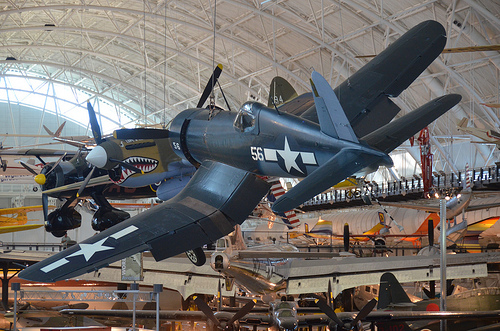
Steven F. Udvar-Hazy Center: Vought F4U-1D Corsair, with P-40 Warhawk in background

Image by Chris Devers
Quoting Smithsonian National Air and Space Museum | Vought F4U-1D Corsair :

By V-J Day, September 2, 1945, Corsair pilots had amassed an 11:1 kill ratio against enemy aircraft. The aircraft’s distinctive inverted gull-wing design allowed ground clearance for the huge, three-bladed Hamilton Standard Hydromatic propeller, which spanned more than 4 meters (13 feet). The Pratt and Whitney R-2800 radial engine and Hydromatic propeller was the largest and one of the most powerful engine-propeller combinations ever flown on a fighter aircraft.

Charles Lindbergh flew bombing missions in a Corsair with Marine Air Group 31 against Japanese strongholds in the Pacific in 1944. This airplane is painted in the colors and markings of the Corsair Sun Setter, a Marine close-support fighter assigned to the USS Essex in July 1944.

Transferred from the United States Navy.

Manufacturer:
Vought Aircraft Company

Date:
1940

Country of Origin:
United States of America

Dimensions:
Overall: 460 x 1020cm, 4037kg, 1250cm (15ft 1 1/8in. x 33ft 5 9/16in., 8900lb., 41ft 1/8in.)

Materials:
All metal with fabric-covered wings behind the main spar.

Physical Description:
R-2800 radial air-cooled engine with 1,850 horsepower, turned a three-blade Hamilton Standard Hydromatic propeller with solid aluminum blades spanning 13 feet 1 inch; wing bent gull-shaped on both sides of the fuselage.

• • • • •

Quoting Smithsonian National Air and Space Museum | Curtiss P-40E Warhawk (Kittyhawk IA):

Whether known as the Warhawk, Tomahawk, or Kittyhawk, the Curtiss P-40 proved to be a successful, versatile fighter during the first half of World War II. The shark-mouthed Tomahawks that Gen. Claire Chennault’s "Flying Tigers" flew in China against the Japanese remain among the most popular airplanes of the war. P-40E pilot Lt. Boyd D. Wagner became the first American ace of World War II when he shot down six Japanese aircraft in the Philippines in mid-December 1941.

Curtiss-Wright built this airplane as Model 87-A3 and delivered it to Canada as a Kittyhawk I in 1941. It served until 1946 in No. 111 Squadron, Royal Canadian Air Force. U.S. Air Force personnel at Andrews Air Force Base restored it in 1975 to represent an aircraft of the 75th Fighter Squadron, 23rd Fighter Group, 14th Air Force.

Donated by the Exchange Club in Memory of Kellis Forbes.

Manufacturer:
Curtiss Aircraft Company

Date:
1939

Country of Origin:
United States of America

Dimensions:
Overall: 330 x 970cm, 2686kg, 1140cm (10ft 9 15/16in. x 31ft 9 7/8in., 5921.6lb., 37ft 4 13/16in.)

Materials:
All-metal, semi-monocoque

Physical Description:
Single engine, single seat, fighter aircraft.

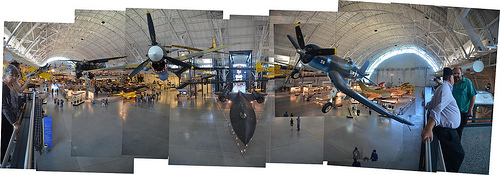
Steven F. Udvar-Hazy Center: Photomontage of main entrance view, including P-40 Warhawk & F-4 Corsair up front, SR-71 Background below in the near distance, and the Space Shuttle Enterprise beyond

Image by Chris Devers
Blogged on ☛ HoloChromaCinePhotoRamaScope‽ as: Bye bye, Miss American Pie.

• • • • •

Quoting Smithsonian National Air and Space Museum | Curtiss P-40E Warhawk (Kittyhawk IA):

Whether known as the Warhawk, Tomahawk, or Kittyhawk, the Curtiss P-40 proved to be a successful, versatile fighter during the first half of World War II. The shark-mouthed Tomahawks that Gen. Claire Chennault’s "Flying Tigers" flew in China against the Japanese remain among the most popular airplanes of the war. P-40E pilot Lt. Boyd D. Wagner became the first American ace of World War II when he shot down six Japanese aircraft in the Philippines in mid-December 1941.

Curtiss-Wright built this airplane as Model 87-A3 and delivered it to Canada as a Kittyhawk I in 1941. It served until 1946 in No. 111 Squadron, Royal Canadian Air Force. U.S. Air Force personnel at Andrews Air Force Base restored it in 1975 to represent an aircraft of the 75th Fighter Squadron, 23rd Fighter Group, 14th Air Force.

Donated by the Exchange Club in Memory of Kellis Forbes.

Manufacturer:
Curtiss Aircraft Company

Date:
1939

Country of Origin:
United States of America

Dimensions:
Overall: 330 x 970cm, 2686kg, 1140cm (10ft 9 15/16in. x 31ft 9 7/8in., 5921.6lb., 37ft 4 13/16in.)

Materials:
All-metal, semi-monocoque

Physical Description:
Single engine, single seat, fighter aircraft.

• • • • •

Quoting Smithsonian National Air and Space Museum | Lockheed SR-71 Blackbird:

No reconnaissance aircraft in history has operated globally in more hostile airspace or with such complete impunity than the SR-71, the world’s fastest jet-propelled aircraft. The Blackbird’s performance and operational achievements placed it at the pinnacle of aviation technology developments during the Cold War.

This Blackbird accrued about 2,800 hours of flight time during 24 years of active service with the U.S. Air Force. On its last flight, March 6, 1990, Lt. Col. Ed Yielding and Lt. Col. Joseph Vida set a speed record by flying from Los Angeles to Washington, D.C., in 1 hour, 4 minutes, and 20 seconds, averaging 3,418 kilometers (2,124 miles) per hour. At the flight’s conclusion, they landed at Washington-Dulles International Airport and turned the airplane over to the Smithsonian.

Transferred from the United States Air Force.

Manufacturer:
Lockheed Aircraft Corporation

Designer:
Clarence L. "Kelly" Johnson

Date:
1964

Country of Origin:
United States of America

Dimensions:
Overall: 18ft 5 15/16in. x 55ft 7in. x 107ft 5in., 169998.5lb. (5.638m x 16.942m x 32.741m, 77110.8kg)
Other: 18ft 5 15/16in. x 107ft 5in. x 55ft 7in. (5.638m x 32.741m x 16.942m)

Materials:
Titanium

Physical Description:
Twin-engine, two-seat, supersonic strategic reconnaissance aircraft; airframe constructed largley of titanium and its alloys; vertical tail fins are constructed of a composite (laminated plastic-type material) to reduce radar cross-section; Pratt and Whitney J58 (JT11D-20B) turbojet engines feature large inlet shock cones.

• • • • •

Quoting Smithsonian National Air and Space Museum | Vought F4U-1D Corsair :

By V-J Day, September 2, 1945, Corsair pilots had amassed an 11:1 kill ratio against enemy aircraft. The aircraft’s distinctive inverted gull-wing design allowed ground clearance for the huge, three-bladed Hamilton Standard Hydromatic propeller, which spanned more than 4 meters (13 feet). The Pratt and Whitney R-2800 radial engine and Hydromatic propeller was the largest and one of the most powerful engine-propeller combinations ever flown on a fighter aircraft.

Charles Lindbergh flew bombing missions in a Corsair with Marine Air Group 31 against Japanese strongholds in the Pacific in 1944. This airplane is painted in the colors and markings of the Corsair Sun Setter, a Marine close-support fighter assigned to the USS Essex in July 1944.

Transferred from the United States Navy.

Manufacturer:
Vought Aircraft Company

Date:
1940

Country of Origin:
United States of America

Dimensions:
Overall: 460 x 1020cm, 4037kg, 1250cm (15ft 1 1/8in. x 33ft 5 9/16in., 8900lb., 41ft 1/8in.)

Materials:
All metal with fabric-covered wings behind the main spar.

Physical Description:
R-2800 radial air-cooled engine with 1,850 horsepower, turned a three-blade Hamilton Standard Hydromatic propeller with solid aluminum blades spanning 13 feet 1 inch; wing bent gull-shaped on both sides of the fuselage.

• • • • •

See more photos of this, and the Wikipedia article.

Details, quoting from Smithsonian National Air and Space Museum | Space Shuttle Enterprise:

Manufacturer:
Rockwell International Corporation

Country of Origin:
United States of America

Dimensions:
Overall: 57 ft. tall x 122 ft. long x 78 ft. wing span, 150,000 lb.
(1737.36 x 3718.57 x 2377.44cm, 68039.6kg)

Materials:
Aluminum airframe and body with some fiberglass features; payload bay doors are graphite epoxy composite; thermal tiles are simulated (polyurethane foam) except for test samples of actual tiles and thermal blankets.

The first Space Shuttle orbiter, "Enterprise," is a full-scale test vehicle used for flights in the atmosphere and tests on the ground; it is not equipped for spaceflight. Although the airframe and flight control elements are like those of the Shuttles flown in space, this vehicle has no propulsion system and only simulated thermal tiles because these features were not needed for atmospheric and ground tests. "Enterprise" was rolled out at Rockwell International’s assembly facility in Palmdale, California, in 1976. In 1977, it entered service for a nine-month-long approach-and-landing test flight program. Thereafter it was used for vibration tests and fit checks at NASA centers, and it also appeared in the 1983 Paris Air Show and the 1984 World’s Fair in New Orleans. In 1985, NASA transferred "Enterprise" to the Smithsonian Institution’s National Air and Space Museum.

Transferred from National Aeronautics and Space Administration