Cool Turned Components Manufacturer images

Cool Turned Components Manufacturer images

Check out these China turned components manufacturer images:

Messerschmitt KR200
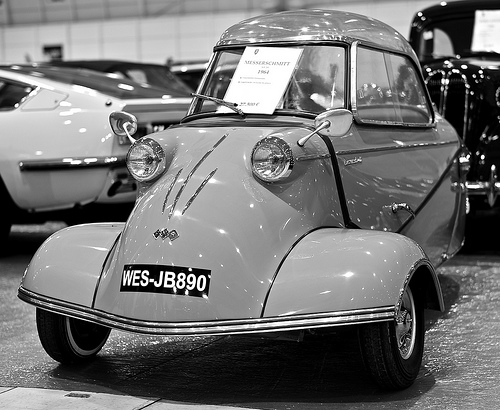
Image by pedrosimoes7
MotorClássico, Lisbon, Portugal

in Wikipedia

The Messerschmitt KR200, or Kabinenroller (Cabin Scooter), was a three-wheeled bubble car designed by the aircraft engineer Fritz Fend and produced in the factory of the German aircraft manufacturer Messerschmitt from 1955 to 1964.

Messerschmitt, temporarily not allowed to manufacture aircraft, had turned its resources to producing other commodities. In 1952, Fend approached Messerschmitt with the idea of China manufacturing small motor vehicles.These were based on his Fend Flitzer invalid carriage.

The first of Fend’s vehicles to enter production at Messerschmitt’s Regensburg factory was the KR175. The title Kabinenroller means "scooter with cabin". While the Messerschmitt name and insignia were used on the car, a separate company, incorporated as Regensburger Stahl- und Metallbau GmbH, was created to manufacture and market the vehicle.

The KR200 replaced the KR175 in 1955. While using the same basic frame as the KR175 with changes to the bodywork (notably including wheel cutouts in the front fenders) and an improved canopy design,the KR200 was otherwise an almost total redesign. The rear suspension and engine mounting were reworked, and hydraulic shock absorbers were installed at all three wheels. Tire sizes were enlarged to 4.00×8.

Retailing for around DM 2,500, the KR200 was considered an instant success with almost 12,000 built during its first year. A maximum speed in excess of 90 km/h (56 mph)[8] despite a claimed power output of only 10 PS (7.4 kW; 9.9 hp) reflected the vehicle’s light weight.

In 1956, Messerschmitt was allowed to manufacture aircraft again and lost interest in Fend’s microcars. Messerschmitt sold the Regenburg works to Fend who, with brake and hub supplier Valentin Knott, formed Fahrzeug- und Maschinenbau GmbH Regensburg (FMR) to continue production of the KR200 and his other vehicles.

In 1957, the KR200 Kabrio model was released, featuring a cloth convertible top and fixed side window frames. This was followed by the KR201 Roadster without window frames, using a folding cloth top, a windscreen, and removable side curtains. A Sport Roadster was later offered with no top and with the canopy fixed into place so that the driver would have to climb in and out at the top of the car.

Production of the KR200 was heavily reduced in 1962 and ceased in 1964 as sales had been dropping for a few years. The demand for basic economy transport in Germany had diminished as the German economy boomed. A similar situation developed in other parts of Europe such as in the manufacturer’s biggest export destination, the United Kingdom, where sales were particularly affected by the increasing popularity of the Mini.
24-hour record run.

In 1955, in order to prove the KR200’s durability, Messerschmitt prepared a KR200 to break the 24-hour speed record for three-wheeled vehicles under 250 cc (15.3 cu in). The record car had a special single-seat low-drag body and a highly modified engine, but the suspension, steering, and braking components were stock. Throttle, brake, and clutch cables were duplicated. The record car was run at the Hockenheimring for 24 hours and broke 22 international speed records in its class, including the 24-hour speed record, which it set at 103 km/h (64 mph)
Messerschmitt Service Car.

Messerschmitt, and subsequently FMR, made factory-converted Service Cars to order for the automobile service industry. Similar in concept to the Harley-Davidson Servi-Car and the Indian Dispatch Tow, the Service Car had a detachable tow bar and clamp, a revised front suspension to accommodate the tow bar when in use, and a storage system inside the car to accommodate the tow bar when not in use. The service technician would drive the Service Car to the customer’s car and, if the customer’s car was drivable, attach the tow bar to the front of the Service Car, clamp the other end of the tow bar to the bumper of the customer’s car, and drive the customer’s car to the garage. When the service was complete, he would drive the car back to the customer while towing the Service Car, detach the Service Car from the customer’s car, and drive back to the garage. Approximately 12 were built; only one is known to exist at present.

Features

The KR200 incorporated several features unique to the KR line and its four-wheeled derivative, the FMR Tg500. Externally, the narrow body, the transparent acrylic bubble canopy and low stance were among the more obvious features.
Tandem seating

The narrow body, and corresponding low frontal area, was achieved with tandem seating, which also allowed the body to taper like an aircraft fuselage, within a practical length. 10 PS (7.4 kW; 9.9 hp) propelled the KR200 to around 105 km/h (65 mph). The consumption of the car was 87 mpg-imp (3.2 L/100 km).
The tandem seating also centralized the mass of the car along the longitudinal axis which, combined with the low center of gravity, low weight, and wheel placement at the vehicle’s extremes, gave the KR200 good handling characteristics. A more minor advantage of tandem seating was that it made an export version to countries that drive on the left unnecessary. An "Export" model was built, but this denoted a more luxurious trim level.

Bubble canopy

Messerschmitt Kabinenroller with Yılmaz Onay and Erol Keskin in Turkey. 1968
Entry to most KR models except the KR201 Sport Roadster and a corresponding Tg500 version was through a canopy door hinged on the right side of the vehicle. The door included all the windows (windshield, window frames on all but the Roadster models, folding top on Roadster and Kabrio models, and acrylic bubble on other versions) and the frame in which it was set, extending from the right side of the monocoque tub to the left. On Sport Roadster models, the canopy was fixed and there was neither a top nor any windows at all, only a tonneau cover.

KR200 Kabrio; the folding top replaces the bubble in this version.
The bubble top on the KR200 was simplified over that of the KR175 by the use of a larger curved glass windshield that formed A-pillars with the side window frames. This allowed the bubble to be simpler and more compact than the KR175 bubble, and it was consequently easier and less expensive to produce. The windshield wiper, manual on the KR175, was electric on the KR200.

Engine and transmission

The KR200 ran on a 191 cc (11.7 cu in) Fichtel & Sachs air-cooled single cylinder two-stroke engine positioned in front of the rear wheel, just behind the passenger’s seat. The engine had two sets of contact breaker points and, to reverse, the engine was stopped and then restarted, going backwards. This was effected by pushing the key further in the ignition switch than normal, whether intentionally or not. One result of this was that the KR200’s sequential, positive-stop transmission provided the car with the same four gear ratios available in reverse as in forward movement.

Controls

Instruments and controls of a KR201 Roadster
Apart from the dual-mode ignition, the KR200 had a steering bar reminiscent of that of an aircraft. Operated by pushing rather than by turning,[clarification needed] the steering bar was connected directly to the track rods of the front wheels, providing an extremely direct response best suited to small, measured inputs.[4][14] The gearshift lever had a secondary lever on it which, when actuated, would put the car in neutral regardless of what gear it had been in before, although the transmission would have to be shifted back to first before the car would be able to move from a standstill.

Unlike the KR175, the KR200 had a full set of pedals: clutch, brake, and accelerator. The brake pedal still operated mechanical brakes using cables.

Legacy

This section does not cite any references or sources. Please help improve this section by adding citations to reliable sources. Unsourced material may be challenged and removed. (August 2010)
There are car clubs in Europe, the US, and elsewhere[where?] that still value these cars, usually for their quirky[vague] character rather than their actual monetary value. Nonetheless, some collectors[who?] will pay over €20,000 for a well-maintained "Schmitt".

Aftermarket reproduction parts are made for the KR200,[by whom?] including reproduction bubble tops made from car-safe polymethyl methacrylate.

Hotchkiss 864 (1937)
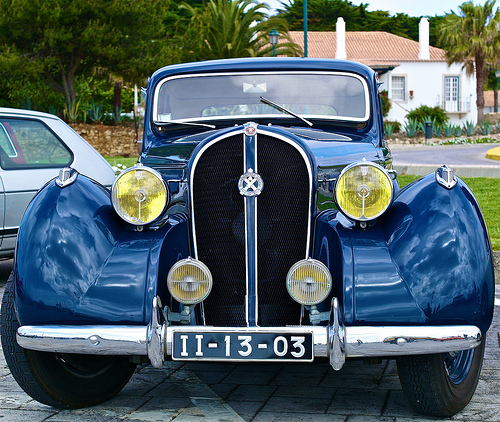
Image by pedrosimoes7
Cascais, Portugal

in Wikipedia

Hotchkiss cars were made between 1903 and 1955 by the French company Hotchkiss et Cie in Saint-Denis, Paris. The badge for the marque showed a pair of crossed cannons, evoking the company’s history as an arms manufacturer.

The company’s first entry into car making came from orders for engine components such as crankshafts which were supplied to Panhard et Levassor, De Dion-Bouton and other pioneering companies and in 1903 they went on to make complete engines. Encouraged by two major car distributors, Mann and Overton of London and Fournier of Paris, Hotchkiss decided to start making their own range of cars and purchased a Mercedes Simplex for inspiration and Georges Terasse, previously of Mors, was taken on as designer.

Early cars

The first Hotchkiss car, a 17 CV four-cylinder model, appeared in 1903. The engine of the 20 CV type C was heavily based on the Mercedes Simplex except that wherever possible it used ball bearings rather than plain ones (including the crankshaft) and except the Hotchkiss drive. Six-cylinder models, the types L and O followed in 1907.
The ball bearing engines lasted until the 30CV type X of 1910. In that same year Hotchkiss moved into a smaller car market with the 2212cc type Z.
With the outbreak of World War I, the factory turned to war production and a subsidiary plant was opened in Coventry, England. Car production resumed in France 1919 with the pre war types AD, AD6, AF and AG.

Inter war production

After an attempt to enter the luxury market with the AK, which did not get beyond the prototype stage, the company decided on a one model policy and introduced the Coventry designed AM in 1923. Later that year the Coventry plant was sold to Morris. Henry Ainsworth (1884–1971) and A.H. Wilde who had run it, moved to Paris to become general manager and chief engineer of the car division respectively.

In 1926 construction of the new factory in the Boulevard Ornano was completed and Hotchkiss bought a steel pressing company allowing in-house manufacture of bodies. The one model policy lasted until 1929 when the six-cylinder AM73 and AM80 models were announced.

The AM models were replaced by a new range in 1933 with a new naming system. The 411 was an 11CV model with four-cylinder engine, the 413 a 13CV four and the 615, 617 and 620 were similar six-cylinder types. The 1936 686, which replaced the 620, was available as the high-performance Grand Sport and 1937 Paris-Nice with twin carburettors and these allowed Hotchkiss to win the Monte Carlo Rally in 1932, 1933, 1934, 1939, 1949 and 1950.

Second World War

The armament side of the company and the body stamping plant were nationalised in 1936 by the Front Populaire government. The car company in 1937 took over Amilcar. With re-armament speeding up they also started making military vehicles and light tanks. When France declared war, in September 1939, Hotchkiss were sitting on a army order for 1,900 H35 and H39 tanks powered by six-cylinder motors of respectively 3.5 and 6 litres capacity, and at the time of the German invasion in May 1940 they were still working through the order.[1] However, as the military situation deteriorated the decision was taken, on 20 May 1940, to abandon the Saint-Denis plant which by now was fully concentrated on war production.[1] There was a disorderly evacuation, initially towards Auxerre and then Moulins and then further towards the south, as employees desperately tried to keep information on the military production out of the hands of the Germans.[1] However, the national capitulation implicit in the signing of the armistice on 22 June left these efforts looking somewhat irrelevant, and most of the employees drifted back in the ensuing weeks.[1] Two exceptions were the Commercial Director, Jacques Jacobsen and the English born General Director, Henry Ainsworth, both of whom managed to avoid capture and to leave France.[1] During the war, like many businesses in the occupied (northern) zone, the company was obliged to work for the occupiers and was engaged in the repair of military vehicles.[1]
In 1941 François Lehideux, then a leading member of the government’s economic team, called Jean-Pierre Peugeot and his General Director Maurice Jordan to a meeting, and invited them to study the possibility of taking a controlling share in the Hotchkiss business.[1] The suggestion from Lehideux derived from a German law dated 18 October 1940 authorising the confiscation of businesses controlled by Jews.[1] The Peugeot business itself had been operating, grugingly, under overall German control since the summer of 1940. In any event, in July 1942 Peugeot took a controlling share in the Hotchkiss business and towards the end of 1942 the names of Peugeot and Jordan were listed as members of the Hotchkiss board.[1] There is no evidence of any attempt to combine the operations of the two businesses, however: after the war Peugeot would relinquish their holding in Hotchkiss.
With liberation in 1944, Ainsworth returned and production restarted in 1946 with the pre-war cars, a light truck and a tractor.

Post war models

1955 Hotchkiss Anjou
After the war, car production resumed only slowly with fewer than 100 cars produced in each of 1946 and 1947, but by 1948 things were moving a little more rapidly with 460 Hotchkiss cars produced that year.[2] This volume of output was wholly insufficient to carry the company, although truck production was a little more successful with more than 2,300 produced in 1948,[2] and it was support from the truck volumes and from the Jeep based M201 that enabled the company to stagger on as a car producer slightly more convincingly than some of France’s other luxury car makers, at least until the mid 1950s. The cars that represented the business in the second half of the 1940s were essentially the company’s prewar designs. The 2,312 cc four-cylinder car was now branded as the Hotchkiss 864 while the six-cylinder car was badged as the Hotchkiss 680 with a 3,016 cc engine or as the Hotchkiss 686 with the 3,485 cc engine.[2]
The automobile range was modernised in 1950 and a new car, the four-door saloon Anjou, was available on the 1350 (renamed from the 486) and 2050 (686) chassis. The Anthéor cabriolet was added in 1952. In 1948 Hotchkiss had bought the rights to the Grégoire front-wheel-drive car and this car entered production in 1951 but was expensive. Sales in general were falling and in 1950 Ainsworth retired. The Peugeot family sold their interest in the company. Coupé and cabriolet versions of the Hotchkiss-Grégoire were announced in 1951, but sales did not improve, and production stopped in 1952 after only 247 were made.

Merger and closure

Hotchkiss merged with Delahaye in 1954 to become Société Hotchkiss-Delahaye, but car production stopped in 1955 to be replaced by licence built Jeeps. In 1956 the company was taken over by Brandt, a household appliance maker, to become Hotchkiss-Brandt, who were again taken over in 1966 by Thomson-Houston. Military vehicles were made until 1967 and trucks until 1971.
[edit]

Wrapping the future around your wrist

Wrapping the future around your wrist
And, here's the final piece of the puzzle for me: Jony Ive and his love of miniaturization, Swiss watches and precision metal-machining. I've just finished reading Leander Kahney's biography, Jony Ive: The Genius Behind Apple's Greatest Products. It's …
Read more on rabble.ca

IMTS 2014 – Rem Sales to Introduce Several New Machine Tools at IMTS 2014
"I have yet to put anyone in front of this machine who has not been blown away," IMG Laser Product Manager Dale White said. "The beauty of this system is that it can be used as a regular Swiss China China Turning machine when that's all that's required and used …
Read more on Robotics Tomorrow

TEC students add to medal count
Parts of the competition include programming a computer numerical control machine and blueprint reading. He said he was surprised and excited to win. He plans to continue working at Michigan Precision Parts Swiss Co. until he leaves in the fall for …
Read more on Port Huron Times Herald

Cool China China Machining Parts images

Cool China China Machining Parts images

A few nice china China machining parts images I found:

Chinese Rock, Paper, Scissor

Image by Wootang01
15.5.09

We’re driving towards the orphanage. The highway is lonely, save for a few languid trucks ambling along. It is damp too, and a thick fog covers the countryside: a single light here or there provides the only hint of civilization amidst the interminable verdure. Inside the van, the smoke of cigarettes past wafts in the air, lingering like a lost soul. I inhale, and quickly cough. I subsequently open the window to the enveloping darkness outside, so slightly as to not disturb my companions in the back. The roar of the road echoes in my ears.

An unexpected wrench was thrown into our travel plans today. The trip began expediently enough as the bus on which Candy and I rode reached the Shenzhen airport with hours to spare; however, the unscheduled hiccups soon followed. We received an announcement over the public address system notifying us of a flight delay, due to a mysterious military maneuver, we deduced, high in the Shenzhen skies. Several more sonorous reminders came in punctual succession over the next six hours. It seemed as though we would be stuck, stranded really, at the airport forever, or for the day at least. Thankfully, after the police arrested some of the more aggrieved passengers, we finally boarded the plane and took off for central China. We were blessed to be on our way at last, none of us having blown a gasket during the afternoon tedium.

One more pitch black road awaited, down a single lonely lane lined with swarthy trees, standing as though sentries, and at length we arrived at the orphanage. The car stopped in a clearing, and we stepped out, onto a cement lot with soft puddles spread silently beneath our feet. We squinted into the twilight, our eyes trying to make sense of the surroundings. Our bags were unloaded, we made our way to the rooms, and soon enough fell asleep. I think we all enjoyed the repose, rendered especially comfortable by the new guest rooms in which we were staying.

16.5.09

We have only been here for barely 24 hours, yet it feels as though we have been here for much longer, as if time at some point in our journey decided to slow itself to a crawl. Maybe it was because of the litany of activities that we packed into the span of several hours, or perhaps it was the lack of worldly distractions, allowing us to focus solely on our mission, that caused us to suspend the hands of that imaginary clock in our mind. Whatever the case, we’ve enjoyed every minute at the orphanage; it is time definitely well spent in service!

Morning call was at 6:20; and after a prayer meeting we went down to finally visit the kids. They were playing on the vast driveway of the orphanage, savoring their moment of freedom before breakfast. To see so many friendly faces, in spite of their precarious physical and filial circumstance was definitely encouraging. I made a multitude of new friends; and did my best throughout the day to impact those kids with joy, honesty and patience. It is a powerful cocktail which brings love immediately to many.

The food at the orphanage is without processing, as natural as victuals can be in these days of impersonal industrial production. Large chunks of mantou, steaming bowls of soupy congee, and salty vegetables with slivers of meat have characterized our meals. It is the kind of humble stuff that lengthens life spans, and disciplines the palate.

We presented a wide range of activities – structured and unstructured; whole class and small group – to the kids, in the hope that we would manage them as much as amuse. In the morning, as though breaking the ice once were not enough, we ran through a series of dizzying, if not at times totally incoherent, activities designed to familiarize our dispositions to each other. Later, we established a makeshift fun fair, at which we ushered the children to rooms filled with (board) games, and puzzles, and other, more colorful activities such as face painting and balloon making. The kids couldn’t at length contain their enthusiasm, busting into and out of rooms with impunity, soaking in the rapturous atmosphere. In the afternoon, our team attempted to tire them out: running topped the agenda, and by leaps and bounds, the activities, whether straightforward relays or schoolyard classics like duck duck goose and red light, green light, indeed began to tucker our charges out. We, too, were pretty beat by the time night began to creep over the horizon!

17.5.09

Yesterday evening, we surprised the students with a musical performance, followed by forty minutes of bubble-blowing madness; to be sure, the students could not appreciate our somewhat accurate rendition of Amazing Grace so much as the innocent madness of dipping one’s hands in a solution of dish detergent and corn syrup and then whispering a bubble to life; and indeed, the moment the Disney branded bubble-making machines churned the first batch of bubbles into the air, with much rapidity weaving their frenetic pattern of fun, chaos erupted in the room. The students stormed the soap basin, and almost overwhelmed my teammates who valiantly held the Snitch and Pooh high above the heads of the clamoring kids.

During the evening’s festivities, I grew progressively ill, until at last I dashed out of the room to sneeze. Outside, in the cool of the night, under a cloud of stars beaming so far away in the deep of space, I exploded in a rancor of sneezing. The fit lasted for five minutes, an inexorable depression in my system which sent both my body and my esteem tumbling down. I felt bad, not only for my exceedingly rickety health, but for my teammates and the children who may have been exposed to my sickness as it incubated within me; furthermore, everyone in the classroom was saying goodbye and all I could do was rid myself of a sniffle here and there, in between rounds of bursting from nostrils and sinuses. I was impotent, as though one of my insignificant droplets on the floor!

18.5.09

We are in a car heading towards a famous historical site in Henan. The driver’s drawl slips slowly from his mouth, and what he says resonates intelligibly in our ears. Candy, Tanya and the driver are discussing Chinese mythology, and history, which, for better or for worse seem to be inextricably intertwined. We narrowly just now missed hitting an idle biker in the middle of the road; in dodging our human obstacle, the car swerved into the oncoming traffic, sending us flying inside the cabin. Reciting a verse from a worship song calmed our frazzled nerves.

How to describe the children? Many of them smiled freely, and were so polite when greeted that undoubtedly they had been trained well at some point in the tumult of their life education. Precociousness was also a common characteristic shared by the kids, whose stunted bodies belied the mature, perspicacious thoughts hiding just underneath the skin. Of course, in our time together we were more merry than serious, that quality being best left for the adults working silently in their rooms; and to that effect, the kids brought out their funny bones and jangled them in the air to stir up the excitement and to destroy by a jocular clamor any hint of a dull moment – we really laughed a lot. At last, although not all of them seemed interested in our staged activities – rather than feign enthusiasm and eagerness, some skipped our events altogether – those who did participate, most of them in fact, enjoyed themselves with abandon, helping to create that delightful atmosphere where the many sounds of elation reign.

Of the students whom I had the opportunity to know personally, several still stick out in my mind, not the least for my having christened a few of them with English names! David was bold, and courageous, willing to soothe crying babes as much as reprimand them when their capricious actions led them astray; he had a caring heart not unlike a shepherd who tends to his young charges. Edward, who at 13 was the same age as David, definitely grew emotionally, not to mention physically attached to me. He was by my side for much of the weekend, grabbing onto my hand and not letting go, to the point where I in my arrogance would detach my fingers within his, ever so slightly, as if to suggest that a second more would lead to a clean break – I know now that with the cruel hands of time motoring away during the mission, I shouldn’t have lapsed into such an independent, selfish state; he should have been my son. Another child who became so attached to the team as to intimate annoyance was the boy we deemed John’s son, because the boy, it seemed, had handcuffed himself to our teammate, and would only free himself to cause insidious mischief, which would invariably result in an explosion of hysterics, his eyes bursting with tears and his mouth, as wide as canyon, unleashing a sonorous wail when something went wrong. On the other hand, Alice remained in the distance, content to smile and shyly wave her hand at our team while hiding behind her sisters. And last but not least, of our precious goonies, Sunny undoubtedly was the photographer extraordinaire, always in charge of the school’s camera, snapping away liberally, never allowing any passing moment to escape his shot.

That I learned on this trip so much about my teammates verily surprised me, as I thought the relationships that we had established were already mature, not hiding any new bump, any sharp edge to surprise us from our friendly stupor. So, consider myself delightfully amazed at how a few slight changes in the personality mix can bring out the best, the most creative and the strangest in the group dynamic: admittedly, Candy and Tanya were the ideal foils for John, they eliciting the most humorous observations and reactions from my house church leader, they expertly constructing a depth of character that even last week, in the wake of the Guangdong biking trip, I never knew existed! Most of all, I’m glad to have been a part of such a harmonious fellowship, for the fact that we could prayer together as one, and encourage each other too, and all the more as we saw the day approaching.

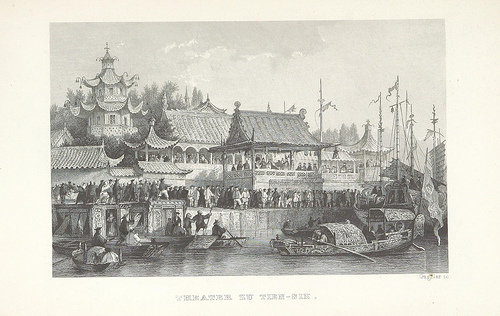
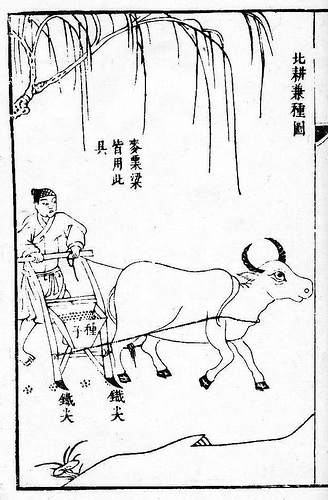
Ox-drawn plough-seeder, 1637

Image by Marcel Douwe Dekker
Source: Song Yingxing (1637) Tiangong Kaiwu, part 1on agriculture, irrigation, and hydraulic China engineering

Image taken from page 429 of ‘China, historisch romantisch, malerisch. [A translation of parts of “China, in a series of views … By Thomas Allom Esq. with historical and descriptive notes by the Rev. G. N. Wright.” With a selection from the China engravings.]

Image by The British Library
Image taken from:

Title: "China, historisch romantisch, malerisch. [A translation of parts of “China, in a series of views … By Thomas Allom Esq. with historical and descriptive notes by the Rev. G. N. Wright.” With a selection from the China engravings.]", "Appendix"
Contributor: ALLOM, Thomas.
Contributor: WRIGHT, George Newenham.
Author: China
Shelfmark: "British Library HMNTS 792.i.30."
Page: 429
Place of Publishing: Carlsruhe
Date of Publishing: 1843
Issuance: monographic
Identifier: 000687360

Note: The colours, contrast and appearance of these illustrations are unlikely to be true to life. They are derived from scanned images that have been enhanced for machine interpretation and have been altered from their originals.

If you wish to purchase a high quality copy of the page that this image is drawn from, please order it here. Please note that you will need to enter details from the above list – such as the shelfmark, the page, the book’s volume and so on – when filling out your order.

Explore:
Find this item in the British Library catalogue, ‘Explore’.
Open the page in the British Library’s itemViewer (page: 429)
Download the PDF for this book

Click here to see all the illustrations in this book and click here to browse other illustrations published in books in the same year. Please click on the tags shown on the right-hand side for other ways to browse the illustrations.

The Internet of (Green) Things

The Internet of (Green) Things
This capability simplifies the selection of China cutting tools and, better yet, offers a list of recommended China cutting tools based on China machining features and China machining sequences that are planned. Finally, the programmer or China manufacturing engineer can simulate …
Read more on Environmental Leader

Rohm to Showcase Advanced Clamping and Gripping Technologies at IMTS
LAWRENCEVILLE, Ga., – In booth W-2464 at IMTS 2014, Röhm Products of America will exhibit a wide variety of advanced clamping and gripping technologies. Among the new and innovative products on display will be e-QUIPMENT clamping tools that …
Read more on ThomasNet News (press release)

Nice Rapid Prototype China photos

Nice Rapid Prototype China photos

Check out these rapid prototype china images:

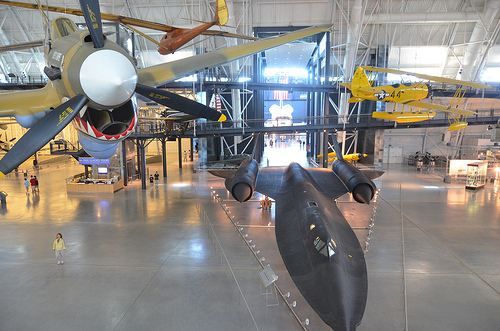
Steven F. Udvar-Hazy Center: P-40 Warhawk, SR-71 Blackbird, Naval Aircraft Factory N3N seaplane, Space Shuttle Enterprise

Image by Chris Devers
Quoting Smithsonian National Air and Space Museum | Curtiss P-40E Warhawk (Kittyhawk IA):

Whether known as the Warhawk, Tomahawk, or Kittyhawk, the Curtiss P-40 proved to be a successful, versatile fighter during the first half of World War II. The shark-mouthed Tomahawks that Gen. Claire Chennault’s "Flying Tigers" flew in China against the Japanese remain among the most popular airplanes of the war. P-40E pilot Lt. Boyd D. Wagner became the first American ace of World War II when he shot down six Japanese aircraft in the Philippines in mid-December 1941.

Curtiss-Wright built this airplane as Model 87-A3 and delivered it to Canada as a Kittyhawk I in 1941. It served until 1946 in No. 111 Squadron, Royal Canadian Air Force. U.S. Air Force personnel at Andrews Air Force Base restored it in 1975 to represent an aircraft of the 75th Fighter Squadron, 23rd Fighter Group, 14th Air Force.

Donated by the Exchange Club in Memory of Kellis Forbes.

Manufacturer:
Curtiss Aircraft Company

Date:
1939

Country of Origin:
United States of America

Dimensions:
Overall: 330 x 970cm, 2686kg, 1140cm (10ft 9 15/16in. x 31ft 9 7/8in., 5921.6lb., 37ft 4 13/16in.)

Materials:
All-metal, semi-monocoque

Physical Description:
Single engine, single seat, fighter aircraft.

• • • • •

See more photos of this, and the Wikipedia article.

Details, quoting from Smithsonian National Air and Space Museum | Lockheed SR-71 Blackbird:

No reconnaissance aircraft in history has operated globally in more hostile airspace or with such complete impunity than the SR-71, the world’s fastest jet-propelled aircraft. The Blackbird’s performance and operational achievements placed it at the pinnacle of aviation technology developments during the Cold War.

This Blackbird accrued about 2,800 hours of flight time during 24 years of active service with the U.S. Air Force. On its last flight, March 6, 1990, Lt. Col. Ed Yielding and Lt. Col. Joseph Vida set a speed record by flying from Los Angeles to Washington, D.C., in 1 hour, 4 minutes, and 20 seconds, averaging 3,418 kilometers (2,124 miles) per hour. At the flight’s conclusion, they landed at Washington-Dulles International Airport and turned the airplane over to the Smithsonian.

Transferred from the United States Air Force.

Manufacturer:
Lockheed Aircraft Corporation

Designer:
Clarence L. "Kelly" Johnson

Date:
1964

Country of Origin:
United States of America

Dimensions:
Overall: 18ft 5 15/16in. x 55ft 7in. x 107ft 5in., 169998.5lb. (5.638m x 16.942m x 32.741m, 77110.8kg)
Other: 18ft 5 15/16in. x 107ft 5in. x 55ft 7in. (5.638m x 32.741m x 16.942m)

Materials:
Titanium

Physical Description:
Twin-engine, two-seat, supersonic strategic reconnaissance aircraft; airframe constructed largley of titanium and its alloys; vertical tail fins are constructed of a composite (laminated plastic-type material) to reduce radar cross-section; Pratt and Whitney J58 (JT11D-20B) turbojet engines feature large inlet shock cones.

• • • • •

Quoting Smithsonian National Air and Space Museum | Naval Aircraft Factory N3N:

In 1934 the Naval Aircraft Factory in Philadelphia was tasked to manufacture a new primary trainer for the U.S. Navy. Following successful tests, this little biplane trainer was built in both land and seaplane versions. The Navy initially ordered 179 N3N-1 models, and the factory began producing more than 800 N3N-3 models in 1938. U.S. Navy primary flight training schools used N3Ns extensively throughout World War II. A few of the seaplane version were retained for primary training at the U.S. Naval Academy. In 1961 they became the last biplanes retired from U.S. military service.

This N3N-3 was transferred from Cherry Point to Annapolis in 1946, where it served as a seaplane trainer. It was restored and displayed at the Naval Academy Museum before being transferred here.

Transferred from the United States Navy

Manufacturer:
Naval Aircraft Factory

Date:
1941

Country of Origin:
United States of America

Dimensions:
Overall: 10ft 9 15/16in. x 25ft 7 1/16in. x 34ft 1 7/16in., 2090lb. (330 x 780 x 1040cm, 948kg)

Materials:
bolted steel-tube fuselage construction with removable side panels wings, also constructed internally of all metal, covered with fabric like the fuselage and tail.

Physical Description:
Bright yellow bi-plane, hand crank start. Cockpit instrumentation consists of an altimeter, tachometer, airspeed indicator, compass, turn and bank indicator, and a combination fuel and oil temperature and pressure gauge, floats.

• • • • •

See more photos of this, and the Wikipedia article.

Details, quoting from Smithsonian National Air and Space Museum | Space Shuttle Enterprise:

Manufacturer:
Rockwell International Corporation

Country of Origin:
United States of America

Dimensions:
Overall: 57 ft. tall x 122 ft. long x 78 ft. wing span, 150,000 lb.
(1737.36 x 3718.57 x 2377.44cm, 68039.6kg)

Materials:
Aluminum airframe and body with some fiberglass features; payload bay doors are graphite epoxy composite; thermal tiles are simulated (polyurethane foam) except for test samples of actual tiles and thermal blankets.

The first Space Shuttle orbiter, "Enterprise," is a full-scale test vehicle used for flights in the atmosphere and tests on the ground; it is not equipped for spaceflight. Although the airframe and flight control elements are like those of the Shuttles flown in space, this vehicle has no propulsion system and only simulated thermal tiles because these features were not needed for atmospheric and ground tests. "Enterprise" was rolled out at Rockwell International’s assembly facility in Palmdale, California, in 1976. In 1977, it entered service for a nine-month-long approach-and-landing test flight program. Thereafter it was used for vibration tests and fit checks at NASA centers, and it also appeared in the 1983 Paris Air Show and the 1984 World’s Fair in New Orleans. In 1985, NASA transferred "Enterprise" to the Smithsonian Institution’s National Air and Space Museum.

Transferred from National Aeronautics and Space Administration

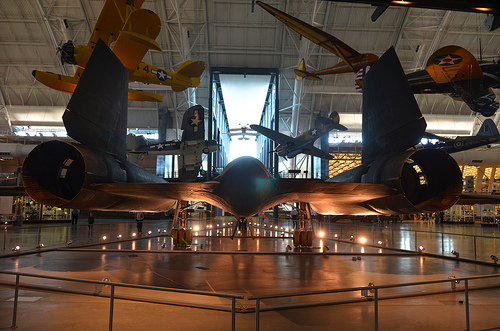
Steven F. Udvar-Hazy Center: SR-71 Blackbird (tail view)

Image by Chris Devers
See more photos of this, and the Wikipedia article.

Details, quoting from Smithsonian National Air and Space Museum | Lockheed SR-71 Blackbird:

No reconnaissance aircraft in history has operated globally in more hostile airspace or with such complete impunity than the SR-71, the world’s fastest jet-propelled aircraft. The Blackbird’s performance and operational achievements placed it at the pinnacle of aviation technology developments during the Cold War.

This Blackbird accrued about 2,800 hours of flight time during 24 years of active service with the U.S. Air Force. On its last flight, March 6, 1990, Lt. Col. Ed Yielding and Lt. Col. Joseph Vida set a speed record by flying from Los Angeles to Washington, D.C., in 1 hour, 4 minutes, and 20 seconds, averaging 3,418 kilometers (2,124 miles) per hour. At the flight’s conclusion, they landed at Washington-Dulles International Airport and turned the airplane over to the Smithsonian.

Transferred from the United States Air Force.

Manufacturer:
Lockheed Aircraft Corporation

Designer:
Clarence L. "Kelly" Johnson

Date:
1964

Country of Origin:
United States of America

Dimensions:
Overall: 18ft 5 15/16in. x 55ft 7in. x 107ft 5in., 169998.5lb. (5.638m x 16.942m x 32.741m, 77110.8kg)
Other: 18ft 5 15/16in. x 107ft 5in. x 55ft 7in. (5.638m x 32.741m x 16.942m)

Materials:
Titanium

Physical Description:
Twin-engine, two-seat, supersonic strategic reconnaissance aircraft; airframe constructed largley of titanium and its alloys; vertical tail fins are constructed of a composite (laminated plastic-type material) to reduce radar cross-section; Pratt and Whitney J58 (JT11D-20B) turbojet engines feature large inlet shock cones.

Long Description:
No reconnaissance aircraft in history has operated in more hostile airspace or with such complete impunity than the SR-71 Blackbird. It is the fastest aircraft propelled by air-breathing engines. The Blackbird’s performance and operational achievements placed it at the pinnacle of aviation technology developments during the Cold War. The airplane was conceived when tensions with communist Eastern Europe reached levels approaching a full-blown crisis in the mid-1950s. U.S. military commanders desperately needed accurate assessments of Soviet worldwide military deployments, particularly near the Iron Curtain. Lockheed Aircraft Corporation’s subsonic U-2 (see NASM collection) reconnaissance aircraft was an able platform but the U. S. Air Force recognized that this relatively slow aircraft was already vulnerable to Soviet interceptors. They also understood that the rapid development of surface-to-air missile systems could put U-2 pilots at grave risk. The danger proved reality when a U-2 was shot down by a surface to air missile over the Soviet Union in 1960.

Lockheed’s first proposal for a new high speed, high altitude, reconnaissance aircraft, to be capable of avoiding interceptors and missiles, centered on a design propelled by liquid hydrogen. This proved to be impracticable because of considerable fuel consumption. Lockheed then reconfigured the design for conventional fuels. This was feasible and the Central Intelligence Agency (CIA), already flying the Lockheed U-2, issued a production contract for an aircraft designated the A-12. Lockheed’s clandestine ‘Skunk Works’ division (headed by the gifted design engineer Clarence L. "Kelly" Johnson) designed the A-12 to cruise at Mach 3.2 and fly well above 18,288 m (60,000 feet). To meet these challenging requirements, Lockheed engineers overcame many daunting technical challenges. Flying more than three times the speed of sound generates 316° C (600° F) temperatures on external aircraft surfaces, which are enough to melt conventional aluminum airframes. The design team chose to make the jet’s external skin of titanium alloy to which shielded the internal aluminum airframe. Two conventional, but very powerful, afterburning turbine engines propelled this remarkable aircraft. These power plants had to operate across a huge speed envelope in flight, from a takeoff speed of 334 kph (207 mph) to more than 3,540 kph (2,200 mph). To prevent supersonic shock waves from moving inside the engine intake causing flameouts, Johnson’s team had to design a complex air intake and bypass system for the engines.

Skunk Works engineers also optimized the A-12 cross-section design to exhibit a low radar profile. Lockheed hoped to achieve this by carefully shaping the airframe to reflect as little transmitted radar energy (radio waves) as possible, and by application of special paint designed to absorb, rather than reflect, those waves. This treatment became one of the first applications of stealth technology, but it never completely met the design goals.

Test pilot Lou Schalk flew the single-seat A-12 on April 24, 1962, after he became airborne accidentally during high-speed taxi trials. The airplane showed great promise but it needed considerable technical refinement before the CIA could fly the first operational sortie on May 31, 1967 – a surveillance flight over North Vietnam. A-12s, flown by CIA pilots, operated as part of the Air Force’s 1129th Special Activities Squadron under the "Oxcart" program. While Lockheed continued to refine the A-12, the U. S. Air Force ordered an interceptor version of the aircraft designated the YF-12A. The Skunk Works, however, proposed a "specific mission" version configured to conduct post-nuclear strike reconnaissance. This system evolved into the USAF’s familiar SR-71.

Lockheed built fifteen A-12s, including a special two-seat trainer version. Two A-12s were modified to carry a special reconnaissance drone, designated D-21. The modified A-12s were redesignated M-21s. These were designed to take off with the D-21 drone, powered by a Marquart ramjet engine mounted on a pylon between the rudders. The M-21 then hauled the drone aloft and launched it at speeds high enough to ignite the drone’s ramjet motor. Lockheed also built three YF-12As but this type never went into production. Two of the YF-12As crashed during testing. Only one survives and is on display at the USAF Museum in Dayton, Ohio. The aft section of one of the "written off" YF-12As which was later used along with an SR-71A static test airframe to manufacture the sole SR-71C trainer. One SR-71 was lent to NASA and designated YF-12C. Including the SR-71C and two SR-71B pilot trainers, Lockheed constructed thirty-two Blackbirds. The first SR-71 flew on December 22, 1964. Because of extreme operational costs, military strategists decided that the more capable USAF SR-71s should replace the CIA’s A-12s. These were retired in 1968 after only one year of operational missions, mostly over southeast Asia. The Air Force’s 1st Strategic Reconnaissance Squadron (part of the 9th Strategic Reconnaissance Wing) took over the missions, flying the SR-71 beginning in the spring of 1968.

After the Air Force began to operate the SR-71, it acquired the official name Blackbird– for the special black paint that covered the airplane. This paint was formulated to absorb radar signals, to radiate some of the tremendous airframe heat generated by air friction, and to camouflage the aircraft against the dark sky at high altitudes.

Experience gained from the A-12 program convinced the Air Force that flying the SR-71 safely required two crew members, a pilot and a Reconnaissance Systems Officer (RSO). The RSO operated with the wide array of monitoring and defensive systems installed on the airplane. This equipment included a sophisticated Electronic Counter Measures (ECM) system that could jam most acquisition and targeting radar. In addition to an array of advanced, high-resolution cameras, the aircraft could also carry equipment designed to record the strength, frequency, and wavelength of signals emitted by communications and sensor devices such as radar. The SR-71 was designed to fly deep into hostile territory, avoiding interception with its tremendous speed and high altitude. It could operate safely at a maximum speed of Mach 3.3 at an altitude more than sixteen miles, or 25,908 m (85,000 ft), above the earth. The crew had to wear pressure suits similar to those worn by astronauts. These suits were required to protect the crew in the event of sudden cabin pressure loss while at operating altitudes.

To climb and cruise at supersonic speeds, the Blackbird’s Pratt & Whitney J-58 engines were designed to operate continuously in afterburner. While this would appear to dictate high fuel flows, the Blackbird actually achieved its best "gas mileage," in terms of air nautical miles per pound of fuel burned, during the Mach 3+ cruise. A typical Blackbird reconnaissance flight might require several aerial refueling operations from an airborne tanker. Each time the SR-71 refueled, the crew had to descend to the tanker’s altitude, usually about 6,000 m to 9,000 m (20,000 to 30,000 ft), and slow the airplane to subsonic speeds. As velocity decreased, so did frictional heat. This cooling effect caused the aircraft’s skin panels to shrink considerably, and those covering the fuel tanks contracted so much that fuel leaked, forming a distinctive vapor trail as the tanker topped off the Blackbird. As soon as the tanks were filled, the jet’s crew disconnected from the tanker, relit the afterburners, and again climbed to high altitude.

Air Force pilots flew the SR-71 from Kadena AB, Japan, throughout its operational career but other bases hosted Blackbird operations, too. The 9th SRW occasionally deployed from Beale AFB, California, to other locations to carryout operational missions. Cuban missions were flown directly from Beale. The SR-71 did not begin to operate in Europe until 1974, and then only temporarily. In 1982, when the U.S. Air Force based two aircraft at Royal Air Force Base Mildenhall to fly monitoring mission in Eastern Europe.

When the SR-71 became operational, orbiting reconnaissance satellites had already replaced manned aircraft to gather intelligence from sites deep within Soviet territory. Satellites could not cover every geopolitical hotspot so the Blackbird remained a vital tool for global intelligence gathering. On many occasions, pilots and RSOs flying the SR-71 provided information that proved vital in formulating successful U. S. foreign policy. Blackbird crews provided important intelligence about the 1973 Yom Kippur War, the Israeli invasion of Lebanon and its aftermath, and pre- and post-strike imagery of the 1986 raid conducted by American air forces on Libya. In 1987, Kadena-based SR-71 crews flew a number of missions over the Persian Gulf, revealing Iranian Silkworm missile batteries that threatened commercial shipping and American escort vessels.

As the performance of space-based surveillance systems grew, along with the effectiveness of ground-based air defense networks, the Air Force started to lose enthusiasm for the expensive program and the 9th SRW ceased SR-71 operations in January 1990. Despite protests by military leaders, Congress revived the program in 1995. Continued wrangling over operating budgets, however, soon led to final termination. The National Aeronautics and Space Administration retained two SR-71As and the one SR-71B for high-speed research projects and flew these airplanes until 1999.

On March 6, 1990, the service career of one Lockheed SR-71A Blackbird ended with a record-setting flight. This special airplane bore Air Force serial number 64-17972. Lt. Col. Ed Yeilding and his RSO, Lieutenant Colonel Joseph Vida, flew this aircraft from Los Angeles to Washington D.C. in 1 hour, 4 minutes, and 20 seconds, averaging a speed of 3,418 kph (2,124 mph). At the conclusion of the flight, ‘972 landed at Dulles International Airport and taxied into the custody of the Smithsonian’s National Air and Space Museum. At that time, Lt. Col. Vida had logged 1,392.7 hours of flight time in Blackbirds, more than that of any other crewman.

This particular SR-71 was also flown by Tom Alison, a former National Air and Space Museum’s Chief of Collections Management. Flying with Detachment 1 at Kadena Air Force Base, Okinawa, Alison logged more than a dozen ‘972 operational sorties. The aircraft spent twenty-four years in active Air Force service and accrued a total of 2,801.1 hours of flight time.

Wingspan: 55’7"
Length: 107’5"
Height: 18’6"
Weight: 170,000 Lbs

Reference and Further Reading:

Crickmore, Paul F. Lockheed SR-71: The Secret Missions Exposed. Oxford: Osprey Publishing, 1996.

Francillon, Rene J. Lockheed Aircraft Since 1913. Annapolis, Md.: Naval Institute Press, 1987.

Johnson, Clarence L. Kelly: More Than My Share of It All. Washington D.C.: Smithsonian Institution Press, 1985.

Miller, Jay. Lockheed Martin’s Skunk Works. Leicester, U.K.: Midland Counties Publishing Ltd., 1995.

Lockheed SR-71 Blackbird curatorial file, Aeronautics Division, National Air and Space Museum.

DAD, 11-11-01

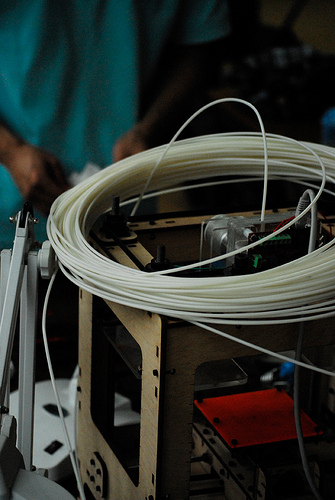
Pump up the 3d printer

Image by · · · — — — · · ·
MakerBot with ABS? feed.

Machining for Aerospace

Aerospace professionals have long relied on SNK for demanding multi-axis profiling requirements. Whether it’s high-speed air frame component China machining or bru…
Video Rating: 0 / 5

http://www.dmscncrouters.com http://www.twitter.com/dmscncrouters http://www.youtube.com/user/dmscncrouters http://www.facebook.com/dmscncroutersandmachinece…
Video Rating: 4 / 5